

Welcome to the Ridgecat Nature Trail
This easy-to-navigate trail gently winds through forested hills and a shallow ravine with an ephemeral stream that is easily crossed by a footbridge. The trail features interpretive signage (with QR codes) identifying common native trees of Virginia as well as native wildflowers. Along the Beechnut Trail you will find an outdoor classroom with benches offering a peaceful place to sit and enjoy the beautiful natural surroundings of our local ecosystem. This is a perfect spot to relax and enjoy the sights and sounds of nature. Common wildlife sightings along the trail are various bird species as well as squirrels, raccoons, and deer.
Angiosperms
American Beech
Fagus grandifolia
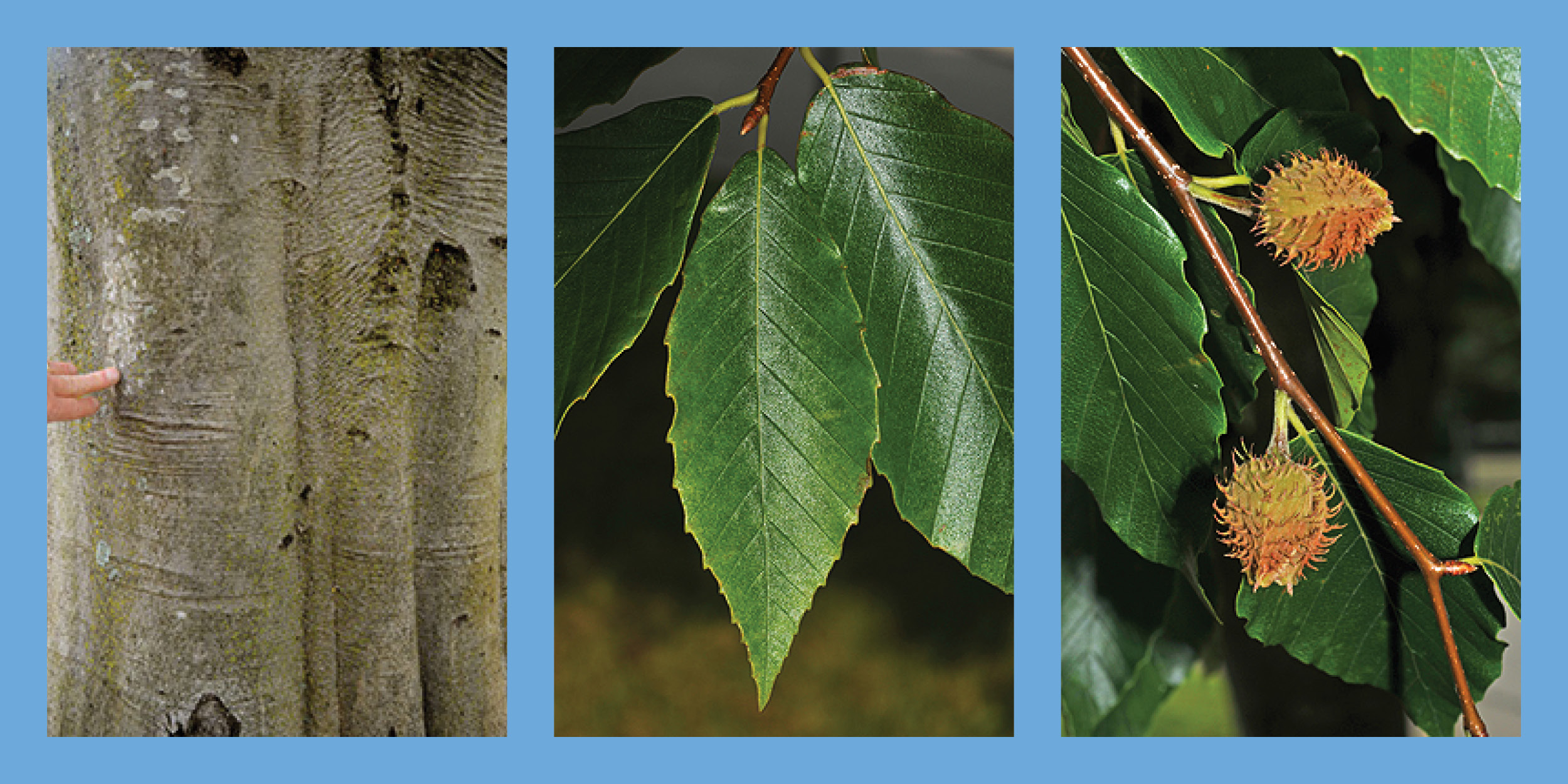
Tree Form: 60-80 ft. tall, irregularly shaped crown, small branches, often retains dead branches on lower portion.
Habitat: Normally found in moist well-draining acidic soil. Prefers open sunny areas but will tolerate the shade. Normally found on north-facing slopes within moist coves.
Leaf: Simple, alternate, oblong to oval pointed leaf, 2-6 inches long and 1-3 inches wide. Leaf has a glossy feel and small incurving teeth. Leaf edge is also rippled/wavy. Leaves turn golden yellow in the fall and later light tan and usually stay on the tree throughout the winter and fall as buds open in the spring.
Flower: Monoecious, greenish white insignificant flowers that bloom from March to May. Male flowers have rounded heads grouped together and droop from 1-inch stalks. Female flowers have short spikes.
Fruit: Produces a 1/2 - 3/4 inch nut consisting of 3-4 triangular nutlets surrounded by prickly burs. The nuts are shiny light-reddish brown. Fruits from in September to October in the fall.
Bark: The bark is thin, light gray, and remains smooth. The tree is often found with large decayed holes near the bottom of the trunk due to a fungal pathogen.
Twig: Branches remain low on Beech as they continue to grow. The twigs are slender and zigzagged with shiny light brown buds that are 3/4 to 1 inch long with overlapping scales. The buds are usually described as being cigar shaped.
Tree use significance: The wood is strong and tough but will rot when exposed to weather or soil. Most often used for furniture, flooring, tools, containers, and fuel. Native Americans used it for medicine and food. The nutlets are preferred by wildlife and hollow trees often used as den sites.
American Holly
Ilex opaca
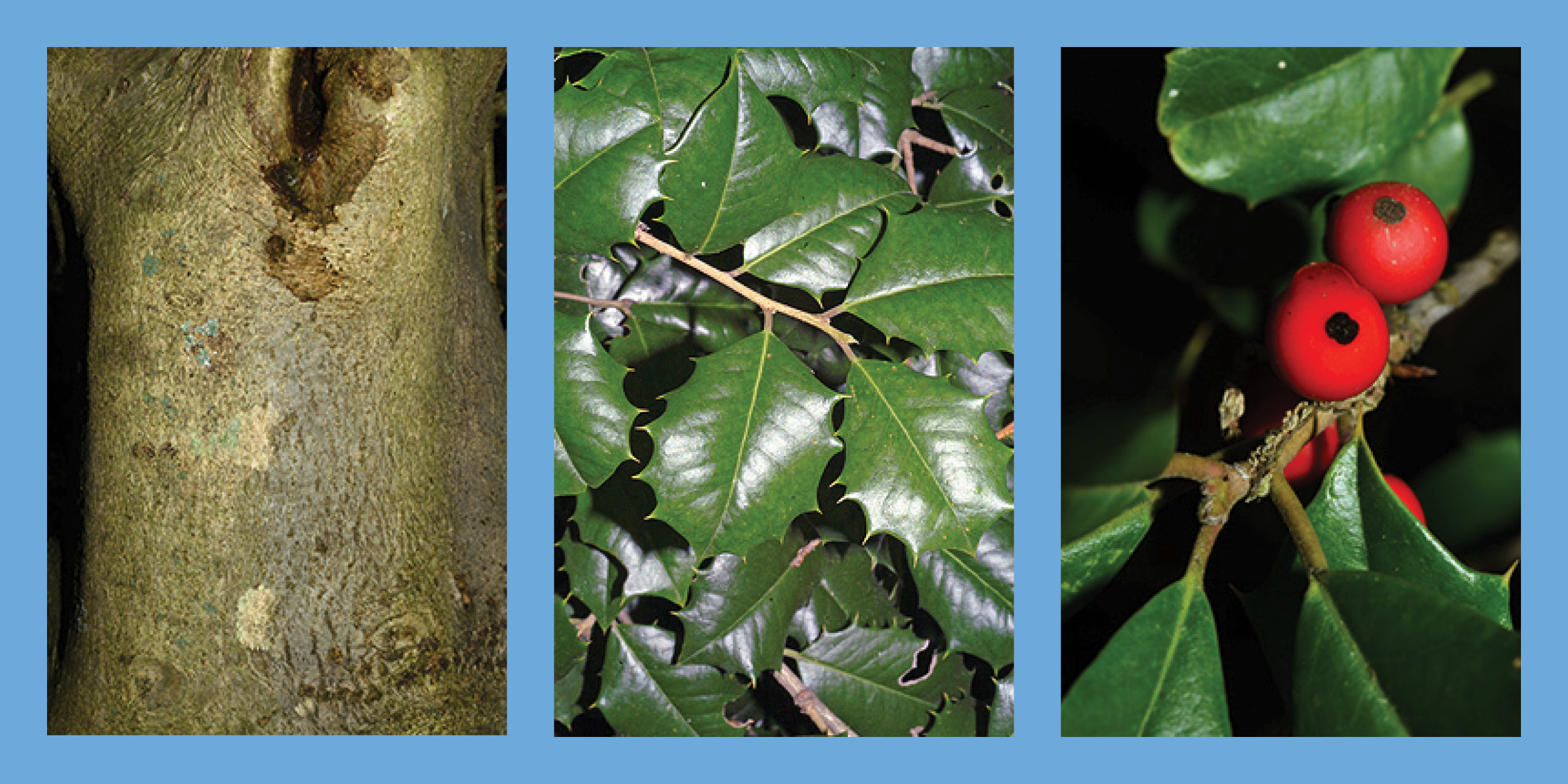
Tree Form: 40 ft tall, Pyramid shape, Nearly Horizontal branch pattern, Fairly straight trunk, Large fluted ridges.
Habitat: Prefers well drained moist soil and partial shade. Many times found in undergrowth.
Leaf: Simple leaf, Alternating arrangement, 2-4 inches in length 1 inch width. Widely spaced repeating spines on each lobe. Thick waxy evergreen leaf with a glossy surface.
Flower: Dioecious tree with dull green to white flower color. Male flowers appear in groups of 3 to 7, female flowers are singular with a pleasant odor. Flowers appear from April to June.
Fruit: Small, round, red berries with brown tips on the bottom, Poisonous to humans.
Bark: Young and Old bark both appear as light gray colored and smooth, changing very little with age. Trunk is fluted with vertical ridges that appear “muscle-like”.
Twig: Slender and rust colored with alternating growth pattern. Buds are reddish brown and pointed. The buds are usually described as being cigar shaped.
Tree use significance: This tree is often used for Christmas decorations, animals also use the berries for food. It is commonly planted outside of buildings as ornamental bushes. The wood can be dyed and then used for fine detailing, as it resembles Ebony when stained.
American Sycamore
Platanus occidentalis
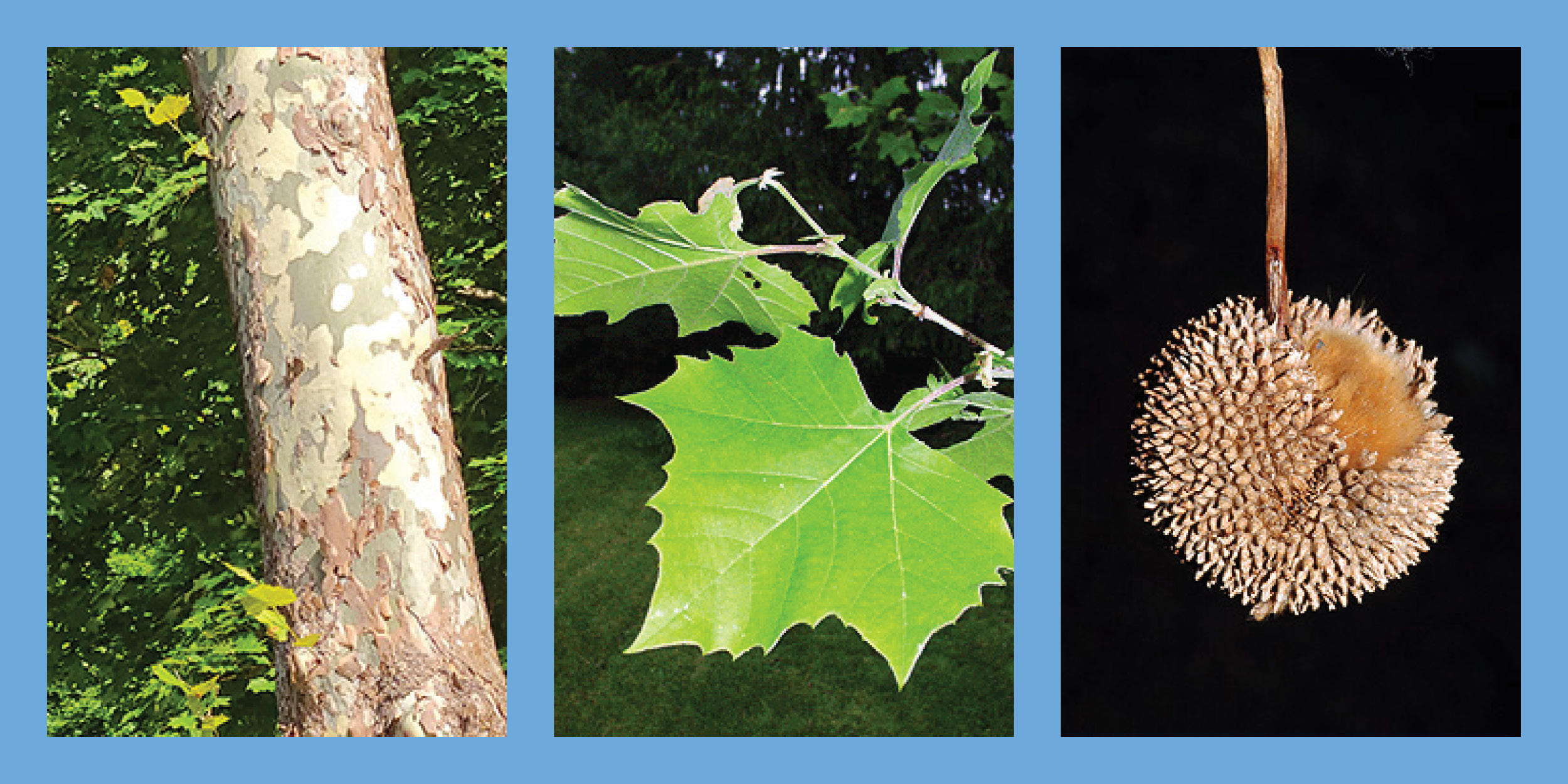
Tree Form: Straight, massive trunk up to 100-150 ft. tall and 3-4 ft. wide or larger on older trees. Crooked branches create an open crown.
Habitat: Thrives in damp environments, such as in stream banks or rich bottomlands.
Leaf: Simple, broad leaf arranged alternately on its branches. Leaves range from 5-8 inches long and wide with a thick, waxy coating. They appear to have 3-5 main lobes and an abundance of shallow sinuses with pointy lobes. Veins are dichotomous even though they appear to originate palmately.
Flower: Tree is monoecious, with male and female flowers appearing very similar. The flower is a small round cluster ranging in colors from reds to yellows. Sycamores bud these flowers in late spring to early summer along with the leaves.
Fruit: It produces a multiple fruit which looks like a fuzzy brown ball about the size of a golf ball with a long 4 in. -5 in. stem. One single fruit contains hundreds of seeds. This tree has one of the fastest germinating seeds. Often found germinating in sandbars in/along streams after flooding.
Bark: Its bark is camouflage-like displaying patches of green, gray, and brown. In younger trees its bark is very smooth. In older trees the bark will peel and crack and exfoliate from the branches and trunk.
Twig: Twigs tend to be considerably stout and thick. They appear orangish-brown and grow in a zigzag manner. Stems have enlarged reddish-brown buds that are hidden under the bark.
Tree use significance: The wood from the Sycamore has been widely used as butcher blocks in the past. Now, it is mainly used for furniture and lower-end products such as crates and posts.
Black Gum
Nyssa sylvatica
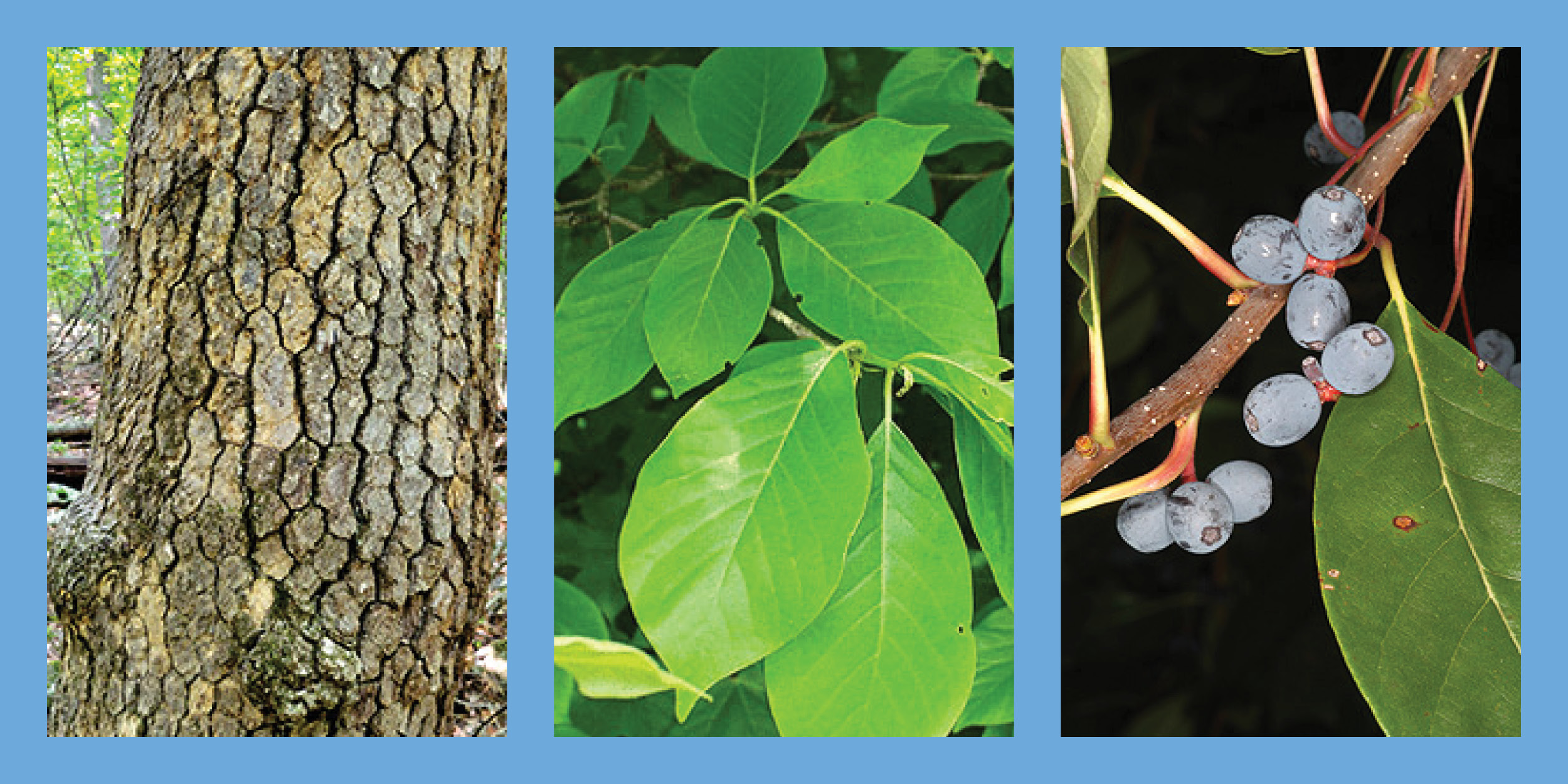
Tree Form: 80-90- ft., conical crown with 90 degree branches/ almost horizontal to the ground, slender branches and twigs often with visible spur shoots. Heartwood often rots and provides home/shelter for wildlife or beehives.
Habitat: South facing slopes, moist, well-drained hardwood forests, often near bodies of water.
Leaf: Simple, alternate, 2-6 in. long, 1-3 in. wide, mostly entire (sometimes irregularly serrated at the tip) Leaves thickly obovate with a long slender apex. Leaves turn bright red in fall.
Flower: Dioecious, staminate (male) are greenish white, spherical clusters, 3-5 in. long. Females are green to white (petals show more white than males), 5 petals, in spherical clusters. Bloom in April- May. It is a bee favorite!
Fruit: 1/4-1/2 in. diameter, purpleish-blue drupe, 2-3 per stalk. Bears love them!
Bark: Young light gray with rectangular plates becoming darker in hue and deeply cracked with age. Bark pattern resembles flat charcoal briquets as tree ages.
Twig: Slender, red-brown to gray, many pale lenticels with alternate terminal buds. Buds are red to brown, short, round, and pointed.
Tree use significance: Historically used for handles, ski poles and flooring because of interlocked grains that prevent splitting. Twigs often chewed and used as natural toothbrushes Excellent shade tree with bright red leaves in fall. Great food source for birds, squirrels, and bees.
Black Locust
Robinia pseudoacacia
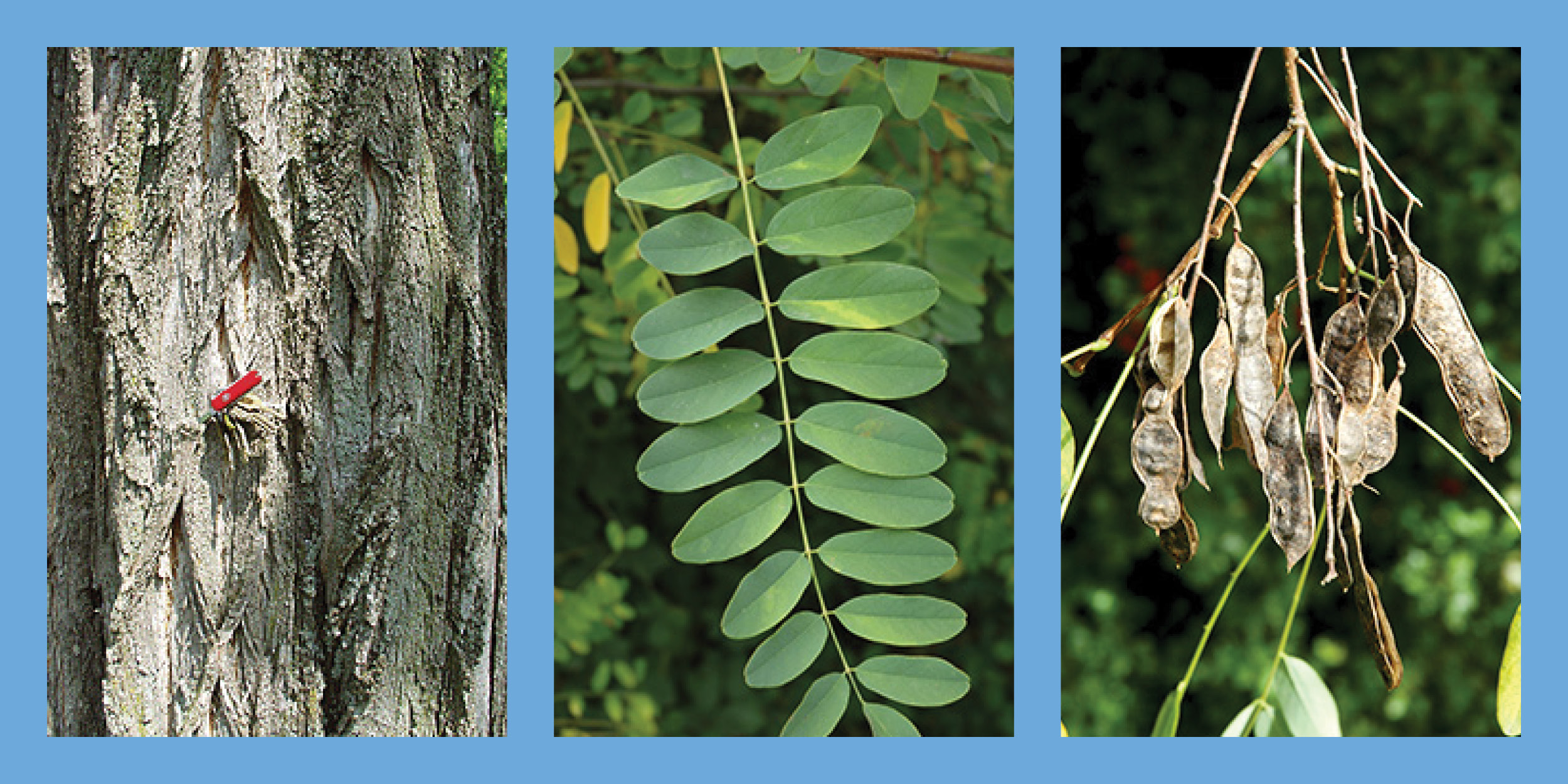
Tree Form: 40-60 ft. tall, straight but often forked trunk with crooked branches. Forms an irregular shaped crown. Very fast growing tree with numerous sucker sprouts.
Habitat: Occurs in moist mountain slopes and dry, rocky soils, often along edges. Prefers north-facing slopes.
Leaf: Alternate leaves, pinnately compound, roughly 8-12 in. long with, 1-2 in. long oval leaflets with entire margins, 7-21 leaflets per leaf.
Flower: Monoecious, white, pea-shaped flowers occur in 4-6 in. long. hanging clusters that are very fragrant. Bloom in April-May and are favored by honeybees!
Fruit: Legumes, 2-4 in. long, dark brown, flat. maturing July-November stays on branches through winter, 3-14 dark brown kidney-shaped seeds.
Bark: Light brown to Gray bark with dark lenticels when immature. Bark forms shallow ridges in “X” or diamond shaped patterns when mature.
Twig: Slender, zig-zag shaped reddish-brown with light lenticels, zig-zag formation, with thorns doubly-present at the nodes on stems near the ground to prevent wildlife foraging.
Tree use significance: It is a nitrogen fixer in the soil and often planted for erosion control for soil improvement. Wood is rot resistant so often used for fence poles and railroad ties.
Common Persimmon
Diospyros virginiana
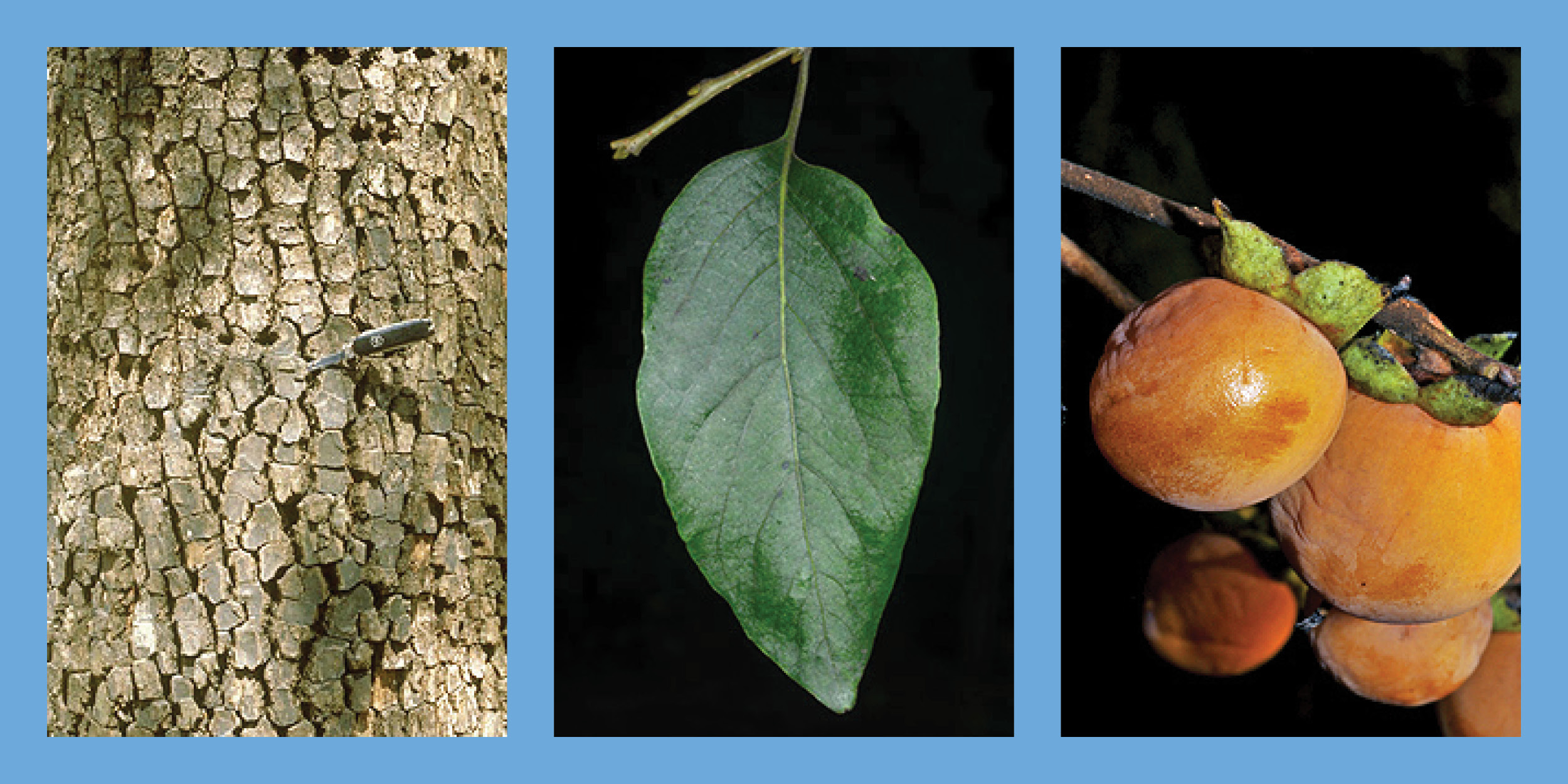
Tree Form: Commonly only grows from 20-60 ft. tall with crooked branches that create a rounded crown.
Habitat: It thrives in many different terrains, including both dry and moist habitats.
Leaf: Simple leaf which grows in an alternate arrangement along the stem. Leaves are oblong-oval with rounded base and pointed tip. Generally 2 to 6 in. long and 2 to 3 in. wide. They are shiny, dark green in color yet have a pale-white underside.
Flower: The Persimmon tree is dioecious, producing male and female flowers on different trees. On females, the flowers are small , thick-leaved, and bell-shaped and greenish-white in color. On males, they are very similar yet grow in small clusters of 3.
Fruit: It produces a 2 inch plum-like berry which starts out yellowish-orange but develops into a deep burgundy shade when ripe. The fruit is very sweet at this stage, yet can be extremely bitter while still in its green state. This fruit contains several 1/2 inch long, flat seeds.
Bark: Bark appears to be grayish-brown on younger trees, and darkens as it ages. With age, it begins to break into thick ridges or scales which will resemble charcoal briquettes.
Twig: The Persimmon has very skinny twigs that are light gray to brown in color. They tend to be fuzzy feeling. It has triangular-shaped dark red buds and its leaves leave a moon or crescent-shaped leaf scar.
Tree use significance: Its hard and durable wood is commonly used for shock-resistant products such as golf club heads. It is also used in construction for things such as shutters and spindles. Fruit is often eaten by humans and wildlife, especially deer and raccoons. Its fruit and bark can be used for many medicinal purposes.
Common Persimmon
Cercis candensis
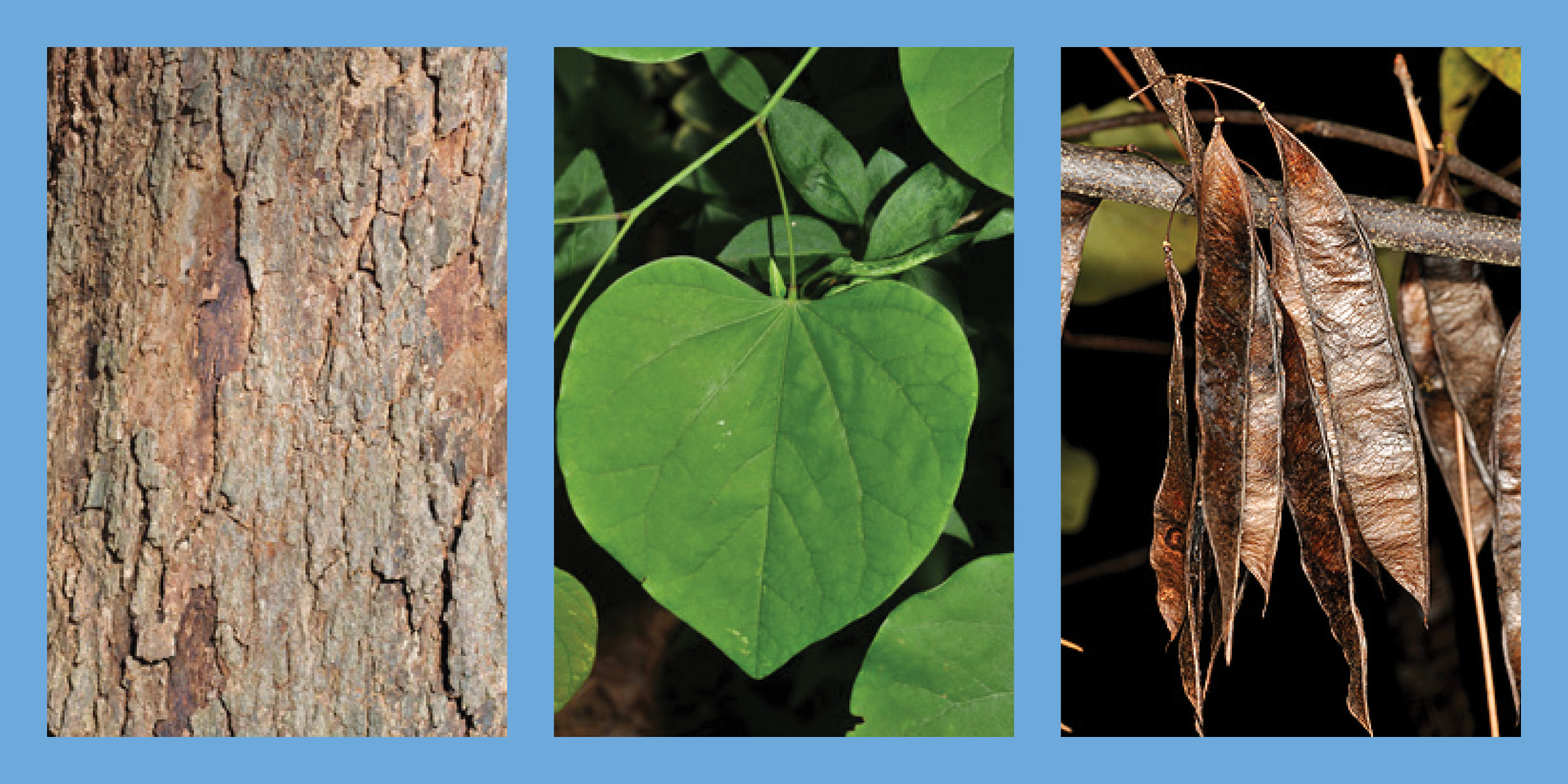
Tree Form: Small tree/shrub with thick, spreading branches and a twisted trunk.
Habitat: Understory tree/shrub found in moist, well drained soil. Prefers sunny locations such as forest edge.
Leaf: Alternate, simple, heart-shaped with smooth edges. Leaf is 2-4 in. long and wide with palmate venation.
Flower: Showy, pink-purple, pea-like flowers (1/2 in.) that are clustered along twigs and branches that show in early spring often before the leaves come out.
Fruit: Flattened, brown, legume, 2-4 in long. Branches have lots of seeds pods.
Bark: Smooth and brown bark early on that later matures into a ridged and furrowed scaly-like reddish-brown bark with maroon and orange patches in the cracks.
Twig: Dark brown to gray/black twigs that are slender and zigzag with lighter pores/lenticels with small leaf buds.
Tree use significance: Fruits are good food source for wildlife. Ornamental tree/shrub. Historically, the bark was used to treat dysentery.
Flowering Dogwood
Cornus florida
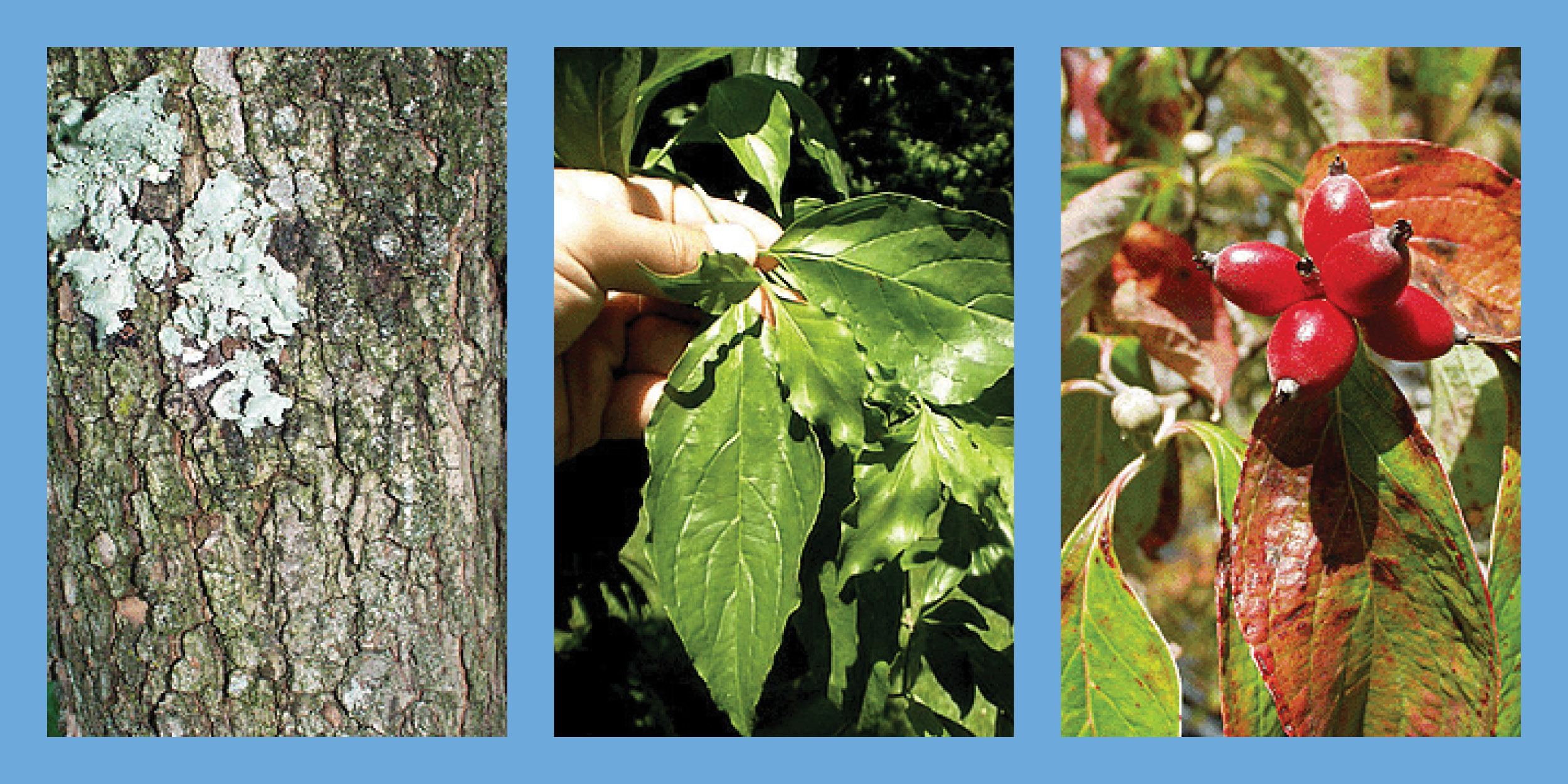
Tree Form: 20 to 30 ft. tall. Small tree with short trunk and low branches. Forms a rounded to flat top crown opposite branches.
Habitat: Understudy of forest, can be on a variety of soils. Prefers sunny location so often found as an edge species along forests and roads.
Leaf: Simple leaf, opposite, 3 to 5 inches long, oval shape, slightly wavy margin, and veins curving to run parallel of the leaf edges.
Flower: Monoecious, small, tight clusters of flowers, 4 petals, large, showy, white-pinkish flower, 2-3 inches wide, Flowers emerge in early to mid-spring.
Fruit: Berry-like drupe, 1/4 to 1/2 inch long, bright red, shiny, drupes in clusters of 3-5. Fruits mature in the fall.
Bark: Young bark is smooth and gray, and then turn scaley to fine looking 1/4 in. blocks resembling puzzle-pieces. Older bark may be grayish-brown.
Twig: Thin, slender, green and slightly purple, overtime turning gray with a waxy coating. Terminal flower buds are clove-shaped and appear very obvious in late fall and winter.
Tree use significance: Historically used for textile spools and/or handles and mallets. The berries are poisonous to humans but eaten by many birds and small mammals. Often used as an ornamental tree. State Tree of Virginia!
Ironwood
Carpinus caroliniana
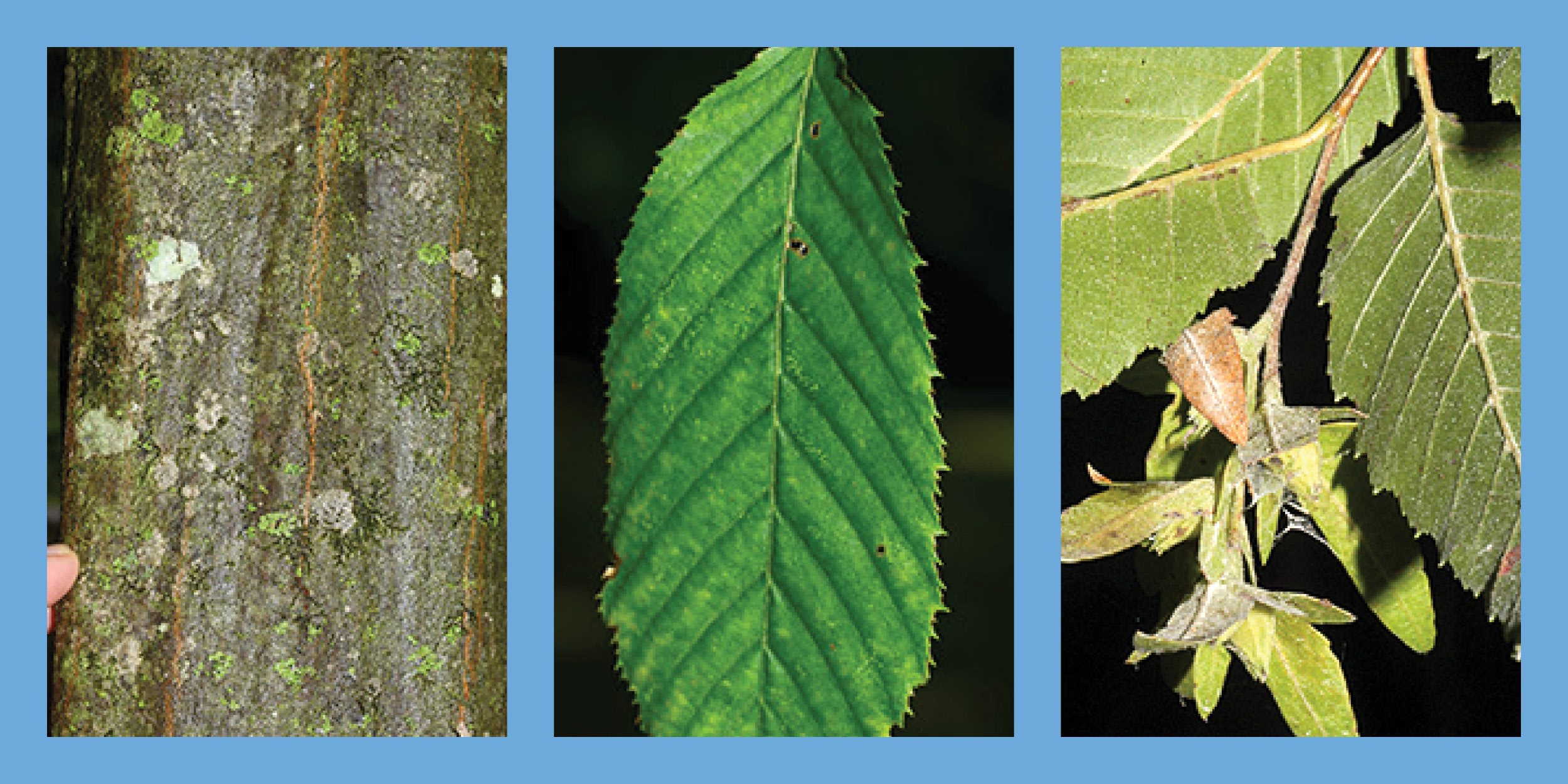
Tree Form: Height generally reaches heights of 20 to 35 feet. Crown is rounded when young and it may be more pyramidal in shape as it matures. Branch pattern tends to grow horizontally and sometimes even drooping a bit. Fluted trunk and branches.
Habitat: Primarily a tree of the forest understory, it generally prefers sites that are moderately moist such as along ponds and streams. It often thrives on slopes and hillsides, and it’s quite adaptable to rocky soils.
Leaf: Simple , alternate leaf that ranges from 2 to 5 inches long and usually about half as wide as they are long. Leaves are doubly serrated having both large and small teeth, giving them a somewhat jagged appearance. Leaves are generally oval or elliptical with a pointed tip.
Flower: Monoecious with both types of flowers arranged in catkins; male flowers are reddish-brown and drooping; female flowers are light green and erect, appearing on new growth in the spring and are less noticeable than the male catkins.
Fruit: Small, dry, single-seeded nutlet. Each nutlet is enclosed in a papery, sac-like structure and these sacs are clustered together in drooping clusters that resemble hops (hence the name “hophornbeam”). Fruit cluster is typically 1 to 3 inches long.
Bark: Young bark is smooth and gray to light brown. Older bark may appear darker bluish-gray. Bark may develop a somewhat fluted appearance that looks like rippling muscles.
Twig: Slender twig is quite zig-zag in appearance. Twigs are brown to gray with 1/4 in. buds with tannish-brown overlapping scales.
Tree use significance: Tough, close-grained wood that is heavy and strong. Often used for tool handles, wooden wheel cogs, mallets and wedges. Beavers are fond of using this tree to build their lodges.
Mockernut Hickory
Carya tomentosa
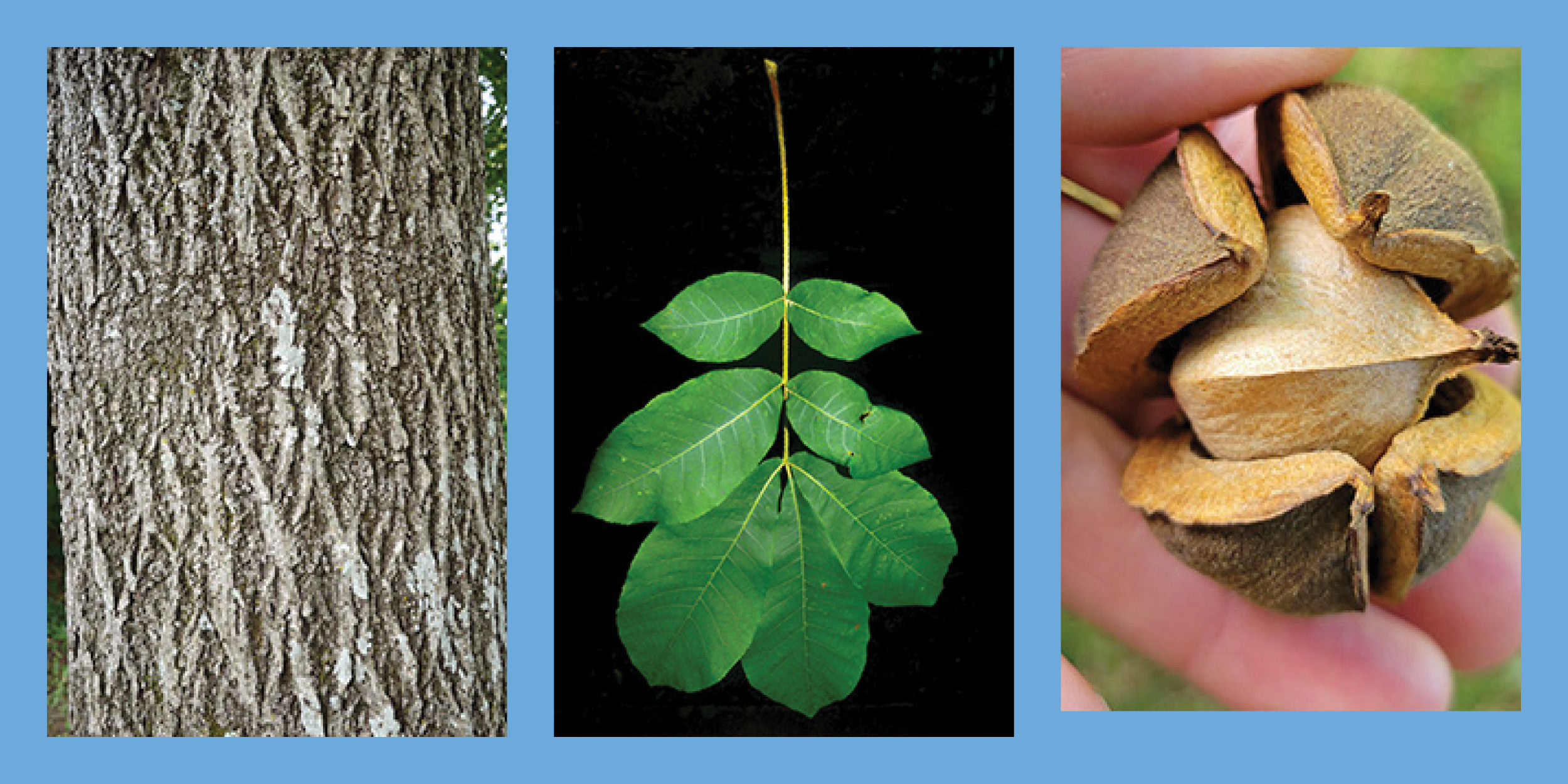
Tree Form: Medium to large tree, 50-80 ft. tall with oval to rounded crown. Branches have a strong upright pattern and spread evenly.
Habitat: Occurs in well-drained upland areas such as ridges and slopes. Prefers deep fertile soils.
Leaf: Alternate, pinnately compound with 7-9 leaflets (normally 7). Leaflets are oblong, finely serrated and 4-8 in. long. Leaf is often hairy on underside. Leaves turn bright yellow in fall.
Flower: Monoecious. Male flowers are yellow-green catkins that grow in clusters. White female flowers are small, inconspicuous, and appear at the tip of twigs. Flowers appear in spring.
Fruit: Nut encased in a thick, four-part husk that splits when ripe. Nut is 1.5 - 2 in. long. Nuts mature in late fall.
Bark: Grayish-brown with thin, shallow ridges forming a deeply furrowed netted pattern as the tree ages.
Twig: Thick, reddish-brown twigs that occur alternately along the stem. End buds are very large and velvety and split open.
Tree use significance: Very heavy, strong, wood with a dark brown heart. Wood often used for tool handles, baseball bats, lumber, fuel, and smoking meats. Nuts are a great food source for wildlife.
Chestnut Oak
Quercus montana
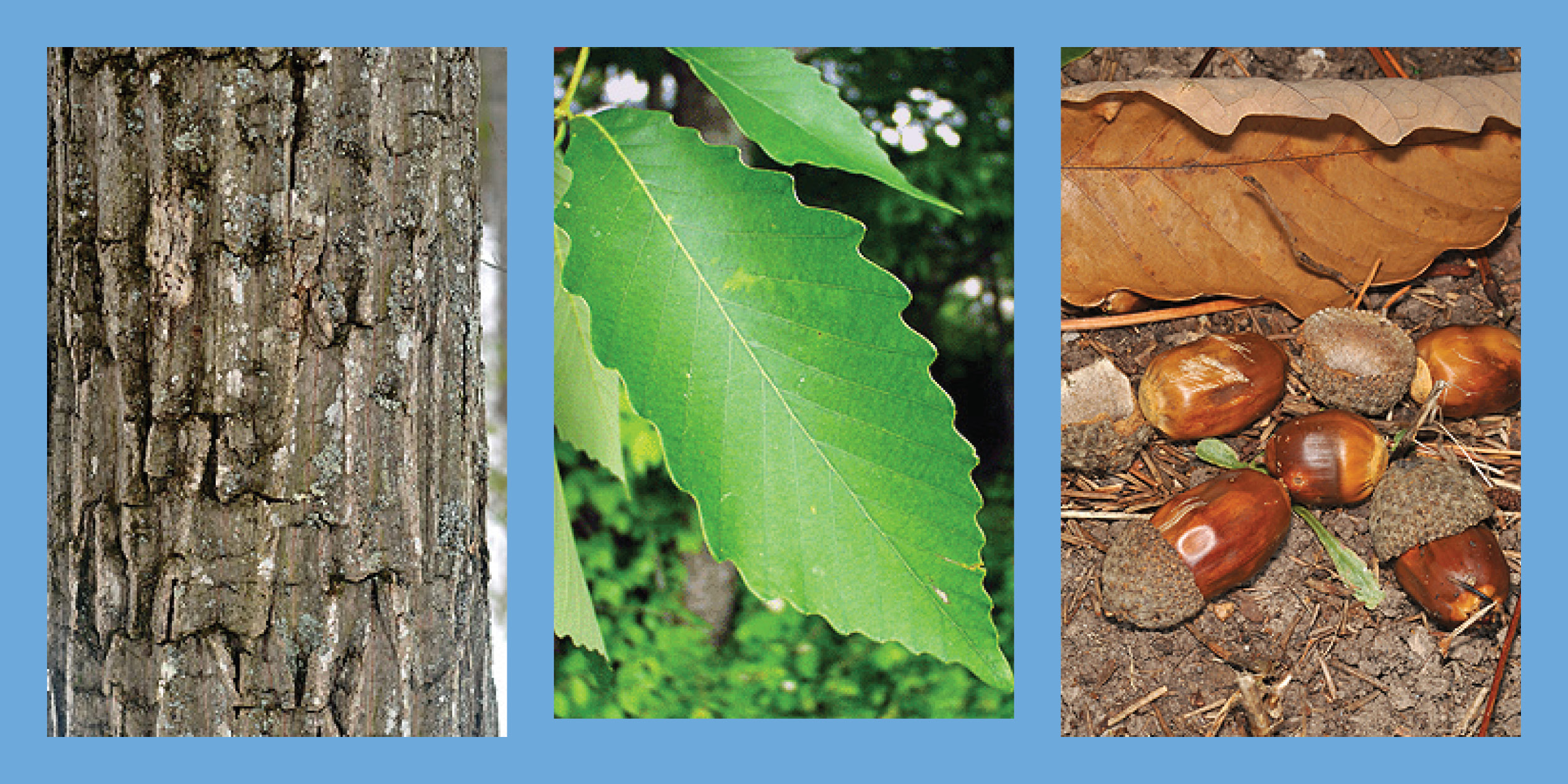
Tree Form: 50 to 80 feet tall, tall, narrow crown, straight trunk, and on drier ridge tops it is smaller with a crooked crown and stem.
Habitat: Normally found on dry, rocky, sloped and ridges. Best growth is in well drained coves, and stream sides.
Leaf: Simple, alternate, oval leaf, 4 to 8 inches long with a crenate margin with large rounded teeth. Leaf gets wider near the tip of the leaf, shiny and light green above. Leaves turn yellow-brown to reddish-brown in fall.
Flower: Monoecious, males are yellow-green catkins, 2-4 inches long. Females are reddish singular spikes. Both appear as leaves develop in mid-spring.
Fruit: Oval Acorn, 1 to 1 1/2 inches long. Cap breaks off easily when mature. Cap is warty and thin along edges. Acorns ripens and often turns yellow in the fall.
Bark: Young trees are grayish-brown and very smooth. Older trees have thick, broad, deeply divided, rounded to flat-topped ridges. Ridges up to 2 inches wide.
Twig: Medium thick twigs are orange-brown to grayish color. Multiple terminal end buds are clustered and quite long. Buds are narrowly pointed and chestnut brown.
Tree use significance: Wood is heavy and strong and resistant to decay. Often used for lumber, beams railroad ties, flooring, furniture, and planking. Acorns are sweet and eaten by a variety of wildlife.
Black Oak
Quercus velutina
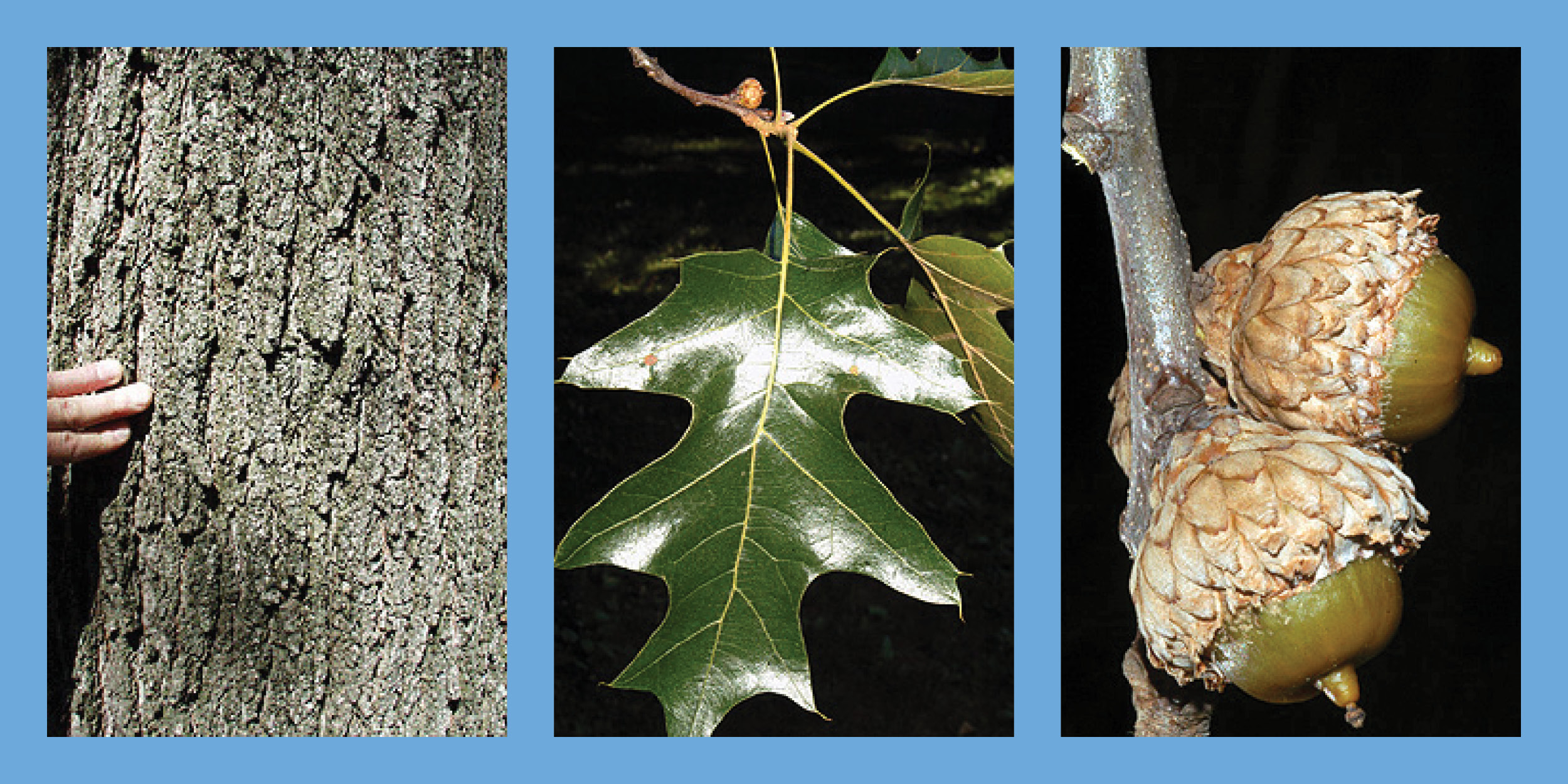
Tree Form: Medium sized tree, 50-80 ft. tall. Tapering, limby trunk with irregular crown. Large shade leaves present.
Habitat: Common on dry ridges and grows best on well-drained soils.
Leaf: Simple, alternate, basically oval leaf, 4-10 in. long with 5-7 bristle-tipped lobes. Leaf is leathery with fuzzy underside. Sun leaves have deep sinuses, shade leaves are broader with shallow sinuses. Leaf turns dull red/bronze in fall.
Flower: Monoecious; male are yellow-green slender catkins, 4-6 in. long, females are reddish-green on singular, short spikes. Flowers appear in spring as leaves form.
Fruit: Oval acorn, 1/2 to 3/4 in. long, thick, reddish-brown, scaly, bowl-shaped cap. Top of acorn may be fuzzy and with stripes along shell. Acorns mature in 2 seasons in the late summer or fall.
Bark: Gray and smooth on younger trees, black and rough on older trees. Bark has deep furrows that break into horizontal blocks. Inside of bark is yellow to reddish-orange and bitter tasting.
Twig: Thick, reddish-brown to gray-green. Twigs may be hairy with up to 1/2 in. long , fuzzy, pointed buds that are angled towards the stem.
Tree use significance: Wood is heavy and strong-grained. Often used for flooring, furniture, fence posts, and railroad ties. Acorns are a valuable wildlife food.
Northern Red Oak
Quercus rubra
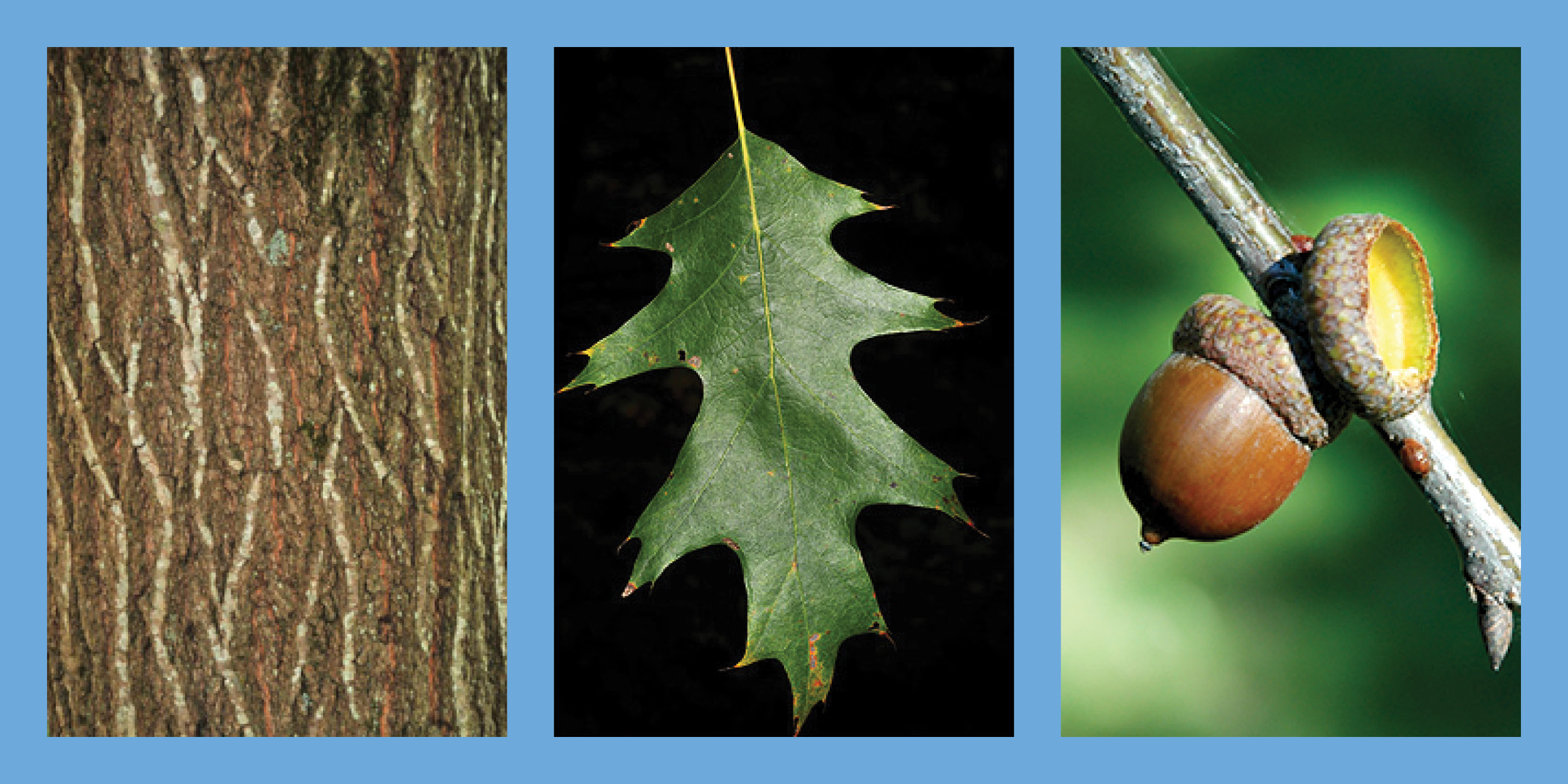
Tree Form: Medium to large size tree, up to 90 feet tall. Develops a short trunk and round crown when grown in the open or a straight trunk with a narrow crown when grown in competition.
Habitat: Grows on deep, well-drained loam to silt-clay soils. Grows best on northerly or easterly slopes, in ravines and coves, and on well-drained valley floors.
Leaf: Simple, alternate, oblong leaf, 5 to 8 inches long, with 7 to 11 bristle-tipped lobes. Sinuses are mostly uniform in shape and extend 1/3 to 1/2 way to midrib. Dull green to blue-green above and paler on underside. Leaves turn red to reddish-brown in the fall.
Flower: Monoecious; males in slender ,yellow-green catkins, 2 to 4 inches long; females are on short spikes. Both appear with the leaves in early spring.
Fruit: Acorns are 3/4 to 1 inch long and nearly round; cap is flat and thick, covering a fourth or less of the acorn, similar to a beret. Acorn matures in 2 growing seasons during late summer or fall.
Bark: Smooth when young; wide, flat-topped ridges and shallow furrows when older. The shallow furrows will be silver-tinted and resemble ski tracts.
Twig: Thick, reddish-brown with multiple terminal buds that are large, conical, and covered with reddish-brown, mostly hairless scales except for terminal buds
Tree use significance: Wood is hard, strong, and course grained. Often used for railroad ties, fence posts, and flooring. Tannin in the bark is useful for tanning hide and creating dyes. Tree provides food and shelter for various animals. Its impressive size makes it a great shade tree, and the vibrant fall colors make it a good landscaping choice.
Pin Oak
Quercus palustris
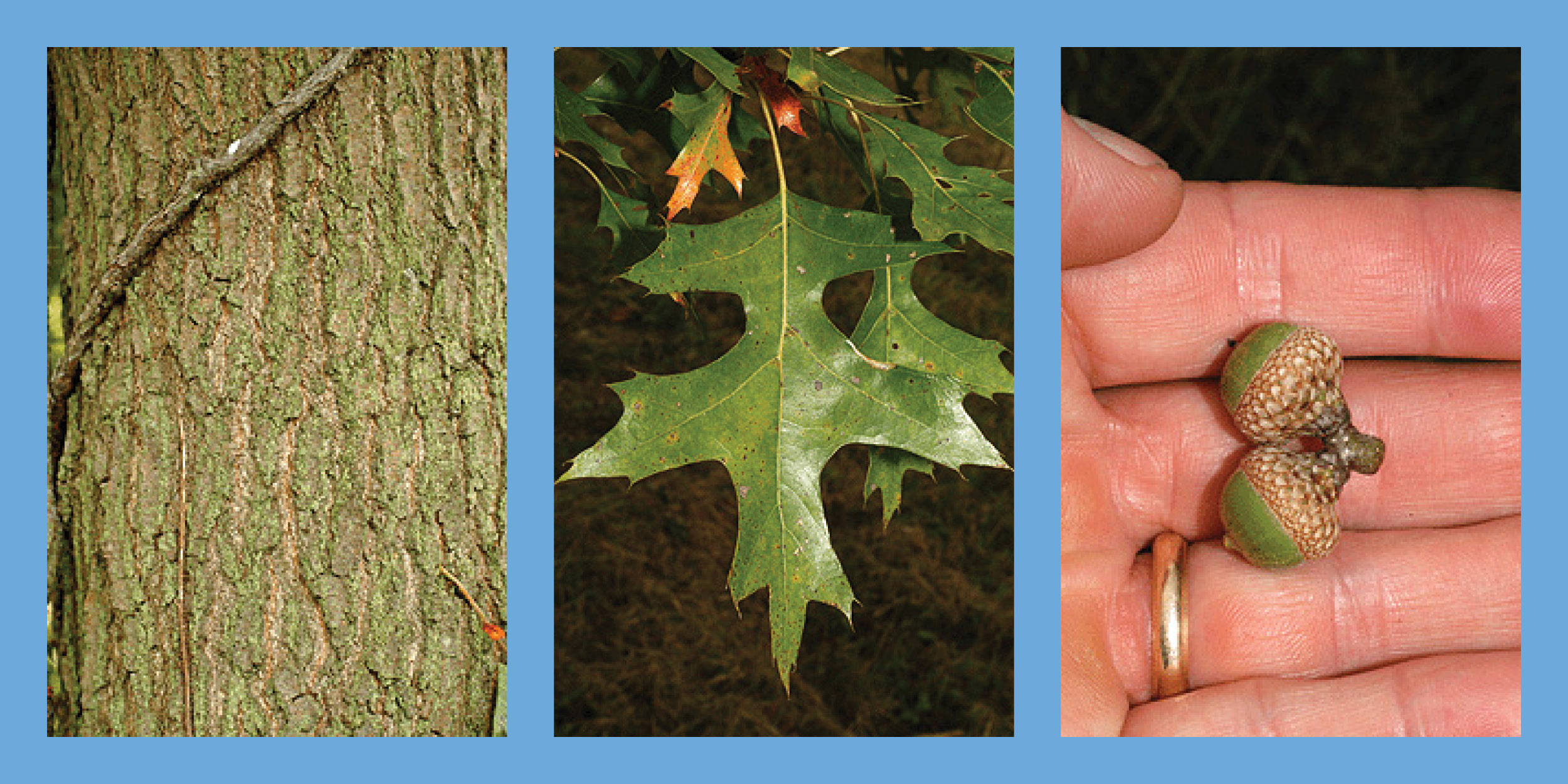
Tree Form: 50-70 ft tall, pyramid-like crown with lower branches that droop and mid-branches are mostly horizontal. Numerous branchlets that give the tree a spiky appearance.
Habitat: Poorly-drained clay soils. Often found in floodplains.
Leaf: Simple, alternate, leaf, 3-6 inches long with 5-9 bristle-tipped lobes separated by deep sinuses that extend to the midrib. Sinuses most often form a “U” shape.
Flower: Monoecious, males are drooping, yellowish-green catkins, 2-4 inches long. Females are single short spikes that are reddish-green in color. Both appear as leaves develop in the spring.
Fruit: Short, round acorn that is only 1/2 inch long. Cap is thin and flattened like a saucer with reddish-brown scales. Fruit matures in 2 years and matures in the fall to early winter.
Bark: Young trees are gray-brown with very tightlyarranged ridges. Older bark will develop flat-topped ridges that are separated by very shallow furrows.
Twig: Twigs are shiny, slender (pen-like), and reddish-brown colored. Multiple terminal buds are small, pointed, and chestnut-brown.
Tree use significance: Heavy and hard wood that is often very knotty. Often used for rough lumber and firewood. Acorns are eaten by a variety of wildlife. Because of its fast growth and tolerance for urban stresses it is a popular landscape tree.
Post Oak
Quercus stellata
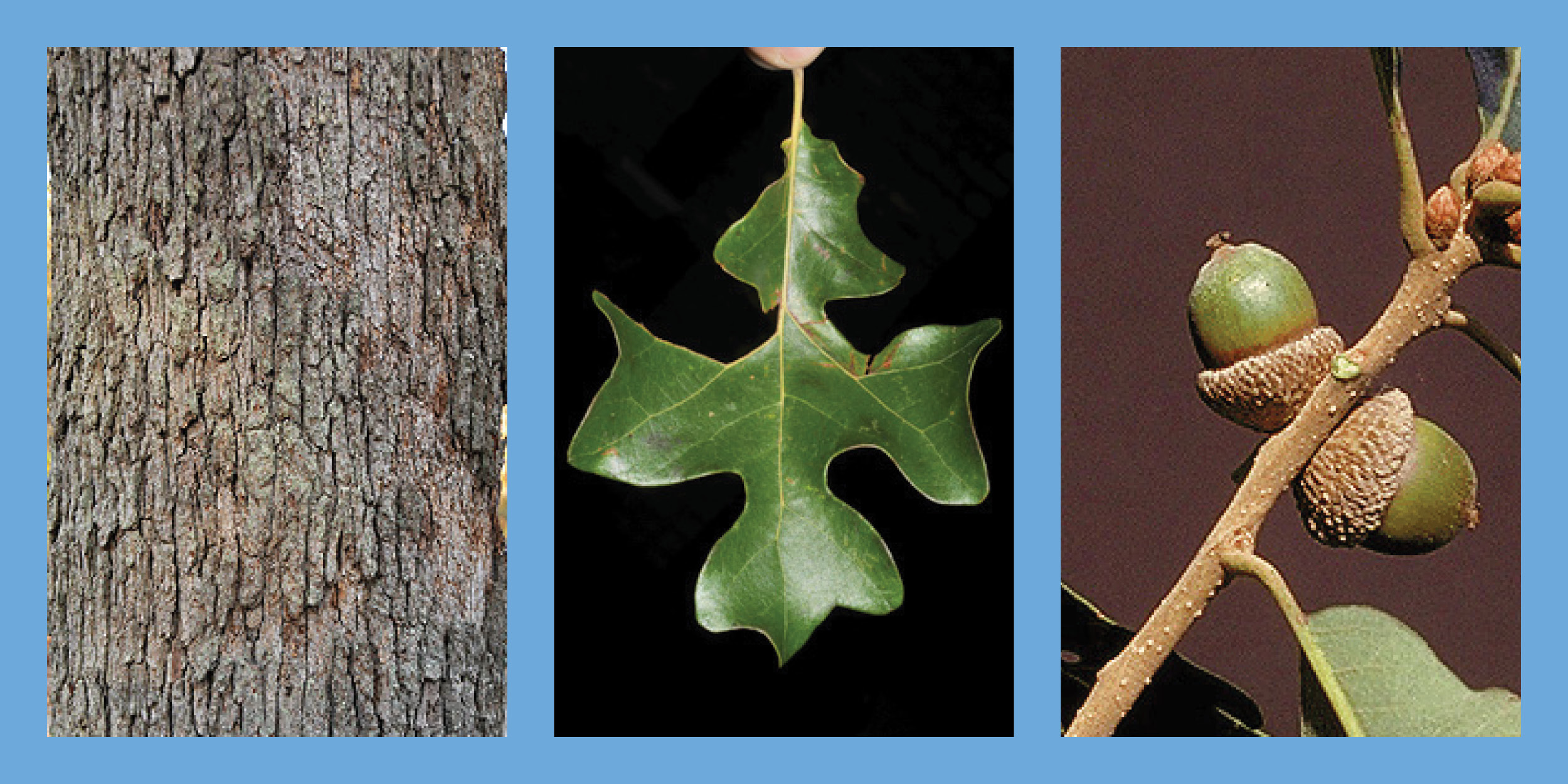
Tree Form: 50-70 ft tall, pyramid-like crown with lower branches that droop and mid-branches are mostly horizontal. Numerous branchlets that give the tree a spiky appearance.
Habitat: Poorly-drained clay soils. Often found in floodplains.
Leaf: Simple, alternate, leaf, 3-6 inches long with 5-9 bristle-tipped lobes separated by deep sinuses that extend to the midrib. Sinuses most often form a “U” shape.
Flower: Monoecious, males are drooping, yellowish-green catkins, 2-4 inches long. Females are single short spikes that are reddish-green in color. Both appear as leaves develop in the spring.
Fruit: Short, round acorn that is only 1/2 inch long. Cap is thin and flattened like a saucer with reddish-brown scales. Fruit matures in 2 years and matures in the fall to early winter.
Bark: Young trees are gray-brown with very tightly arranged ridges. Older bark will develop flat-topped ridges that are separated by very shallow furrows.
Twig: Twigs are shiny, slender (pen-like), and reddish-brown colored. Multiple terminal buds are small, pointed, and chestnut-brown.
Tree use significance: Heavy and hard wood that is often very knotty. Often used for rough lumber and firewood. Acorns are eaten by a variety of wildlife. Because of its fast growth and tolerance for urban stresses it is a popular landscape tree.
Scarlet Oak
Quercus coccinea
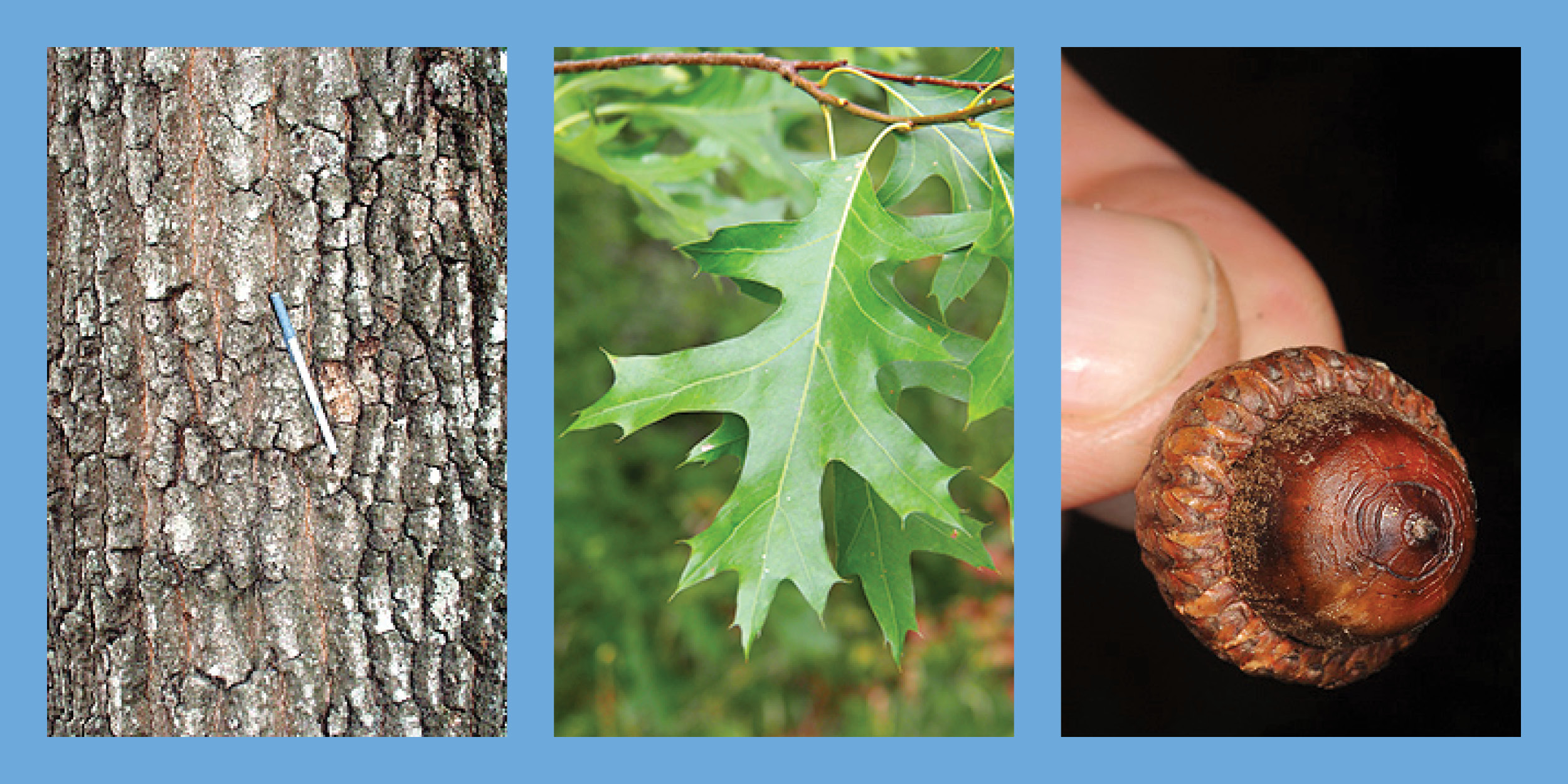
Tree Form: 60-80 ft. tall, small branches, irregularly shaped crown, often retains dead branches on lower portion.
Habitat: Normally found on dry, rocky, well-drained ridges.
Leaf: Simple, alternate, 4-7 inches long and 3-5 inches wide, 5-9 lobes with bristle tips, wide “C-Shaped” sinuses that almost reach the midvein. Leaves turn a beautiful scarlet in fall.
Flower: Monoecious, inconspicuous. Males are long, slender, yellowish-green catkins. Females are tiny reddish-green flowers with no petals. Flowers in spring after leaves emerge.
Fruit: Acorn, 1-1.5 inches, oval shaped. The cap is “bowl-shaped” and covers almost half of the acorn. The tip of the acorn is often ringed with circles appearing as a “target.”
Bark: Smooth, gray bark on young trees, darker gray as it matures into broad irregular ridges with narrow furrows.
Twig: Thick, reddish-brown, alternate twigs. Clustered, reddish-brown end buds that point outward. Winter: end buds are clustered standing out against bare twigs. Spring: buds swell and remain clustered.
Tree use significance: Historically valued for its adaptability in urban settings and use in parks, particularly in 19th and early 20th-century landscaping. Commonly used for making railroad ties, fence posts, and firewood due to its hardness and workability. Symbols of strength, resilience, and endurance in various cultures. Common nicknames include “Red Oak” (though it differs from Northern Red Oak) and “Spotted Oak”
White Oak
Quercus alba
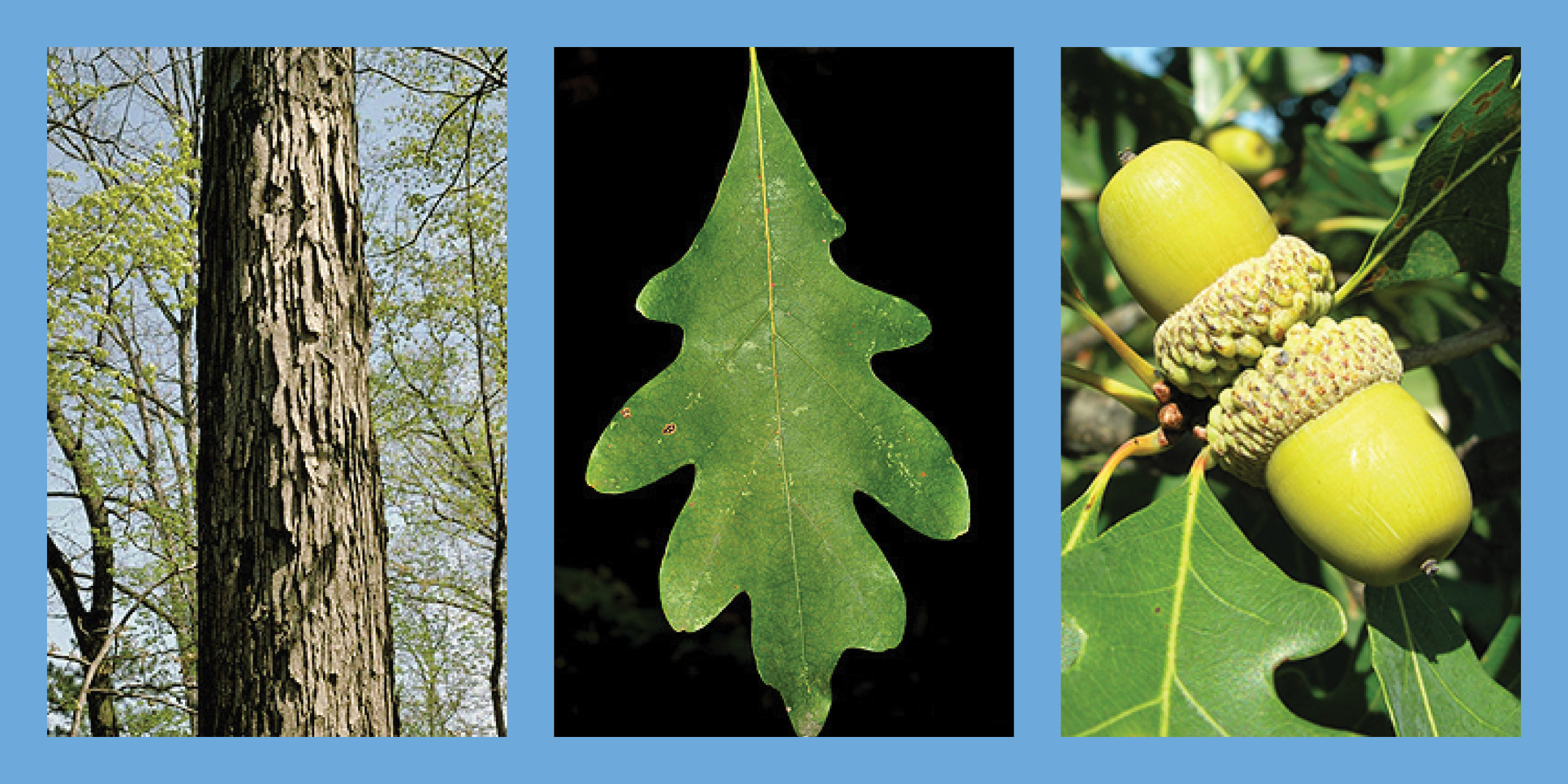
Tree Form: Very tall tree, 80-100 ft., stocky and rugged trunk with irregular, wide-spreading crown. When grown in competition in forests crown is oval and more upright.
Habitat: Often found on a wide variety of upland sites. Grows best on deep, well-drained, loamy soils.
Leaf: Simple, alternate, oblong to ovate leaf, 4-7 in. long, with 7-10 rounded lobes. Sinuses can vary from deep to shallow. Leaf base is angular where it joins the petiole. Leaf is green above and paler on underside. Leaves turn reddish-orange to burgundy in fall.
Flower: Monoecious; males are yellow-green 2-4 in. catkins, females are reddish-green singular spikes. Flowers appear as leaves appear in the spring.
Fruit: Oblong acorn, 3/4 in. long. Cap is warty and bowl-shaped and covers 1/4 of acorn. Cap always detaches when fruit is ripe. Fruit matures in 1 season in early fall.
Bark: White to ash-gray scales are very flaky. Bark scales/plates overlap like shingles
Twig: Reddish-brown, to gray or purplish that may appear shiny. Multiple end buds are small, rounded, reddish-brown and hairless.
Tree use significance: Wood is heavy, strong, close-grained, and very durableOften used for lumber, barrels, furniture, interior wood finish, and flooring. Makes an impressive ornamental tree for yards and is valued for its sweet acorns for wildlife, especially deer, bear, squirrels, and turkey.
Pignut Hickory
Carya glabra
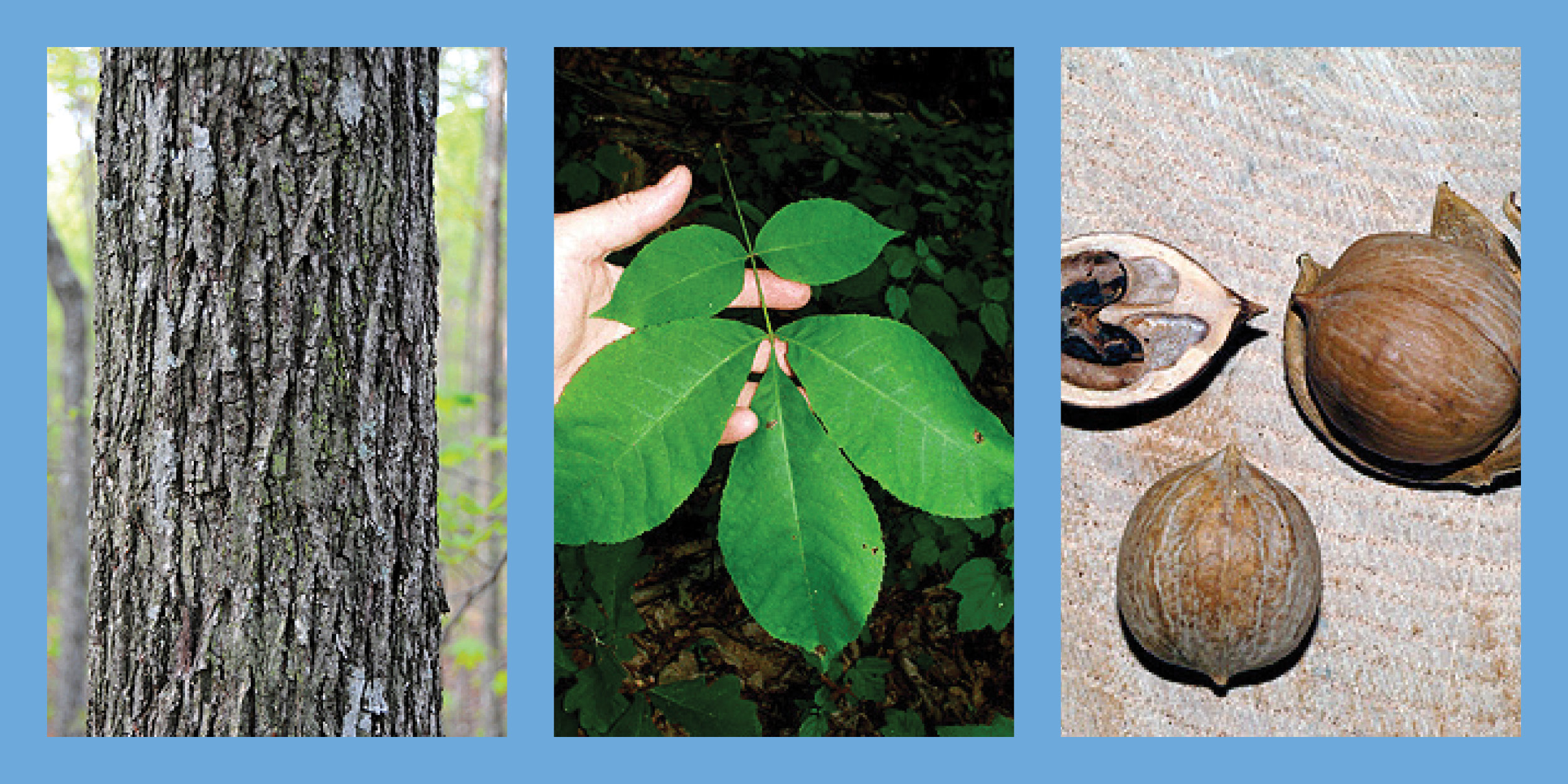
Tree Form: Typically 50-80ft tall, straight trunk with a rounded crown.
Habitat: Mainly dry-mesic forests, woodlands and ridges or forest edge.
Leaf: Compound, alternating leaves, typically 8-12 inches long with 5 leaflets per leaf. Each leaflet 3-6 inches long with a toothed or serrated margin. *rarely with 7 leaflets per compound leaf.
Flower: Monoecious, inconspicuous male and female flowers. Male flowers are yellow-green catkins that are 2-3 inches long. Female flowers are green in short spikes that emerge in clusters at the tips of branches. Flowers generally open from mid-March to June.
Fruit: Nut is round/oblong to pear shaped with a short beak that turns up slightly. 1-2.5 inches long.
Bark: Gray to dark-gray bark with a rough, interlacing pattern of thin, shallow ridges and cracks that form flat-topped ridges forming a diamond pattern with age.
Twig: Moderately thick, reddish-brown to gray in color. Small, egg-shaped buds covered with reddish brown scales.
Tree use significance: Very hard and dense wood useful to create tools requiring strength and impact resistance such as hand-tool handles. Nuts are favored by many types of mammalian wildlife.
Red Maple
Acer Rubrum
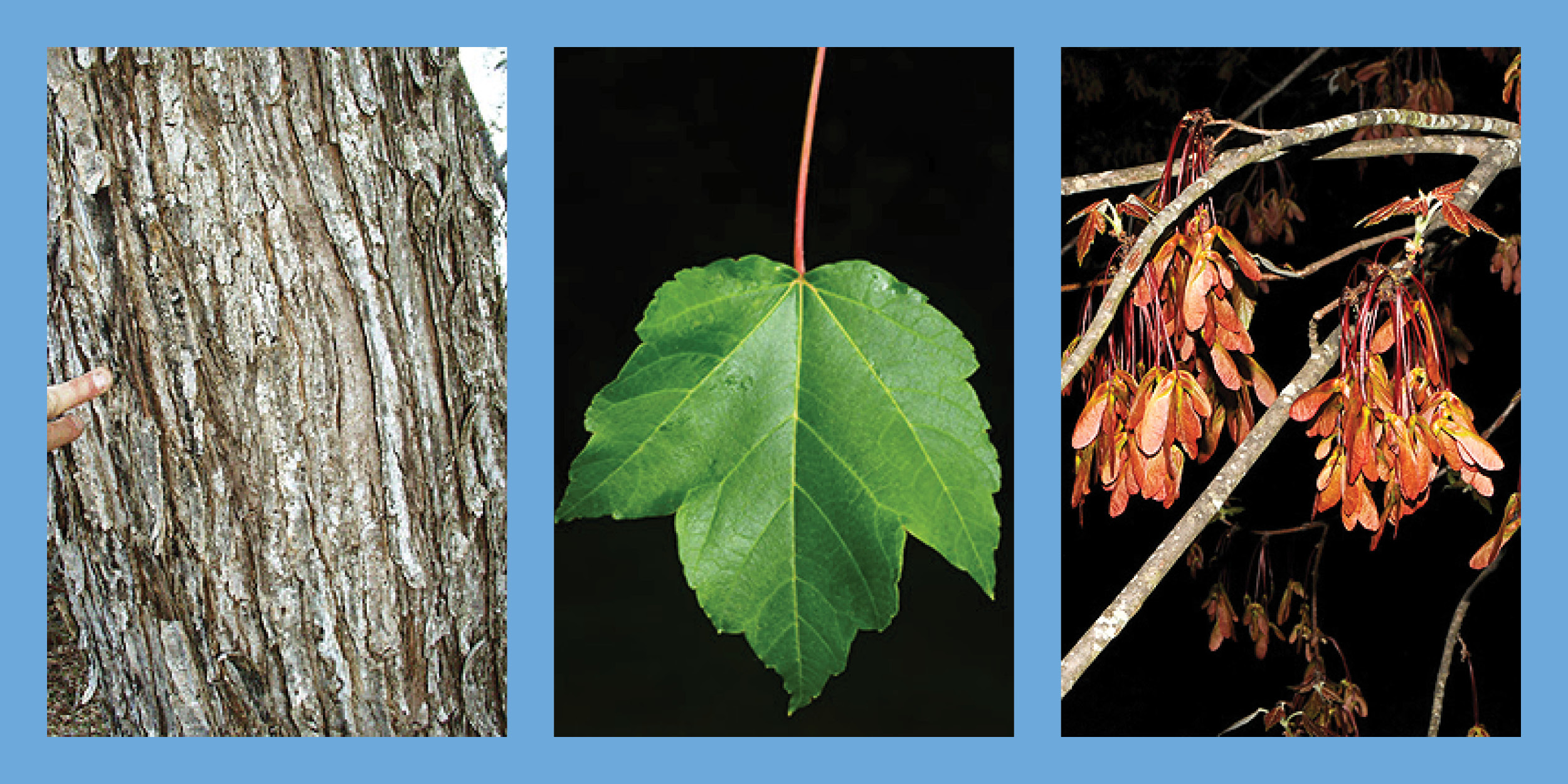
Tree Form: 40-60 ft tall with rounded crown with shorter trunk when grown in the open. Crown will be more narrow and trunk taller in the forest.
Habitat: Various habitat from dry ridges, to woodlands, to swamps. Can tolerate a wide variety of soils and moisture levels.
Leaf: Simple, opposite, 3- 5 palmate lobes with serrated margins and palmate venation. Leaves normally 2-4 in. long. Leaf margin will be doubly toothed and pointed and sinuses will be rather shallow but distinctly “v” shaped. Leaves are darker green above and paler green below. Leaf petiole often reddish colored. Leaves turn brilliant red to reddish/orange in the fall.
Flower: Monoecious, small, bright red insignificant flowers grow in hanging clusters and appear before the leaves in the spring.
Fruit: Clustered, paired, winged samaras grow on long, thin, drooping stems. Samaras are normally reddish colored and 1/2 -3/4 in long. Samaras will ripen in late spring or early summer and spin as they detach and fall to the ground. Samaras often appear before or as the leaves appear.
Bark: Young trees are smooth and light gray. Older bark will develop darker ridges that will eventually break into long, plate-like scales as the tree matures.
Twig: Twigs are reddish and shiny with numerous tiny lenticels. Terminal buds are blunt shaped and green to reddish-green in color. Buds normally have a few loose scales. Buds and branches will be opposite along the stem.
Tree use significance: Wood is heavy, close-grained, but fairly weak and prone to limb breakage during wind/ice storms. Wood used for furniture, woodenware, and paper pulp. Fruits and buds are a favored food for wildlife, especially squirrels, birds, mice, and deer for browsing. Popular landscape tree because of its small size and brilliant color in the fall.
Silver Maple
Acer saccharinum
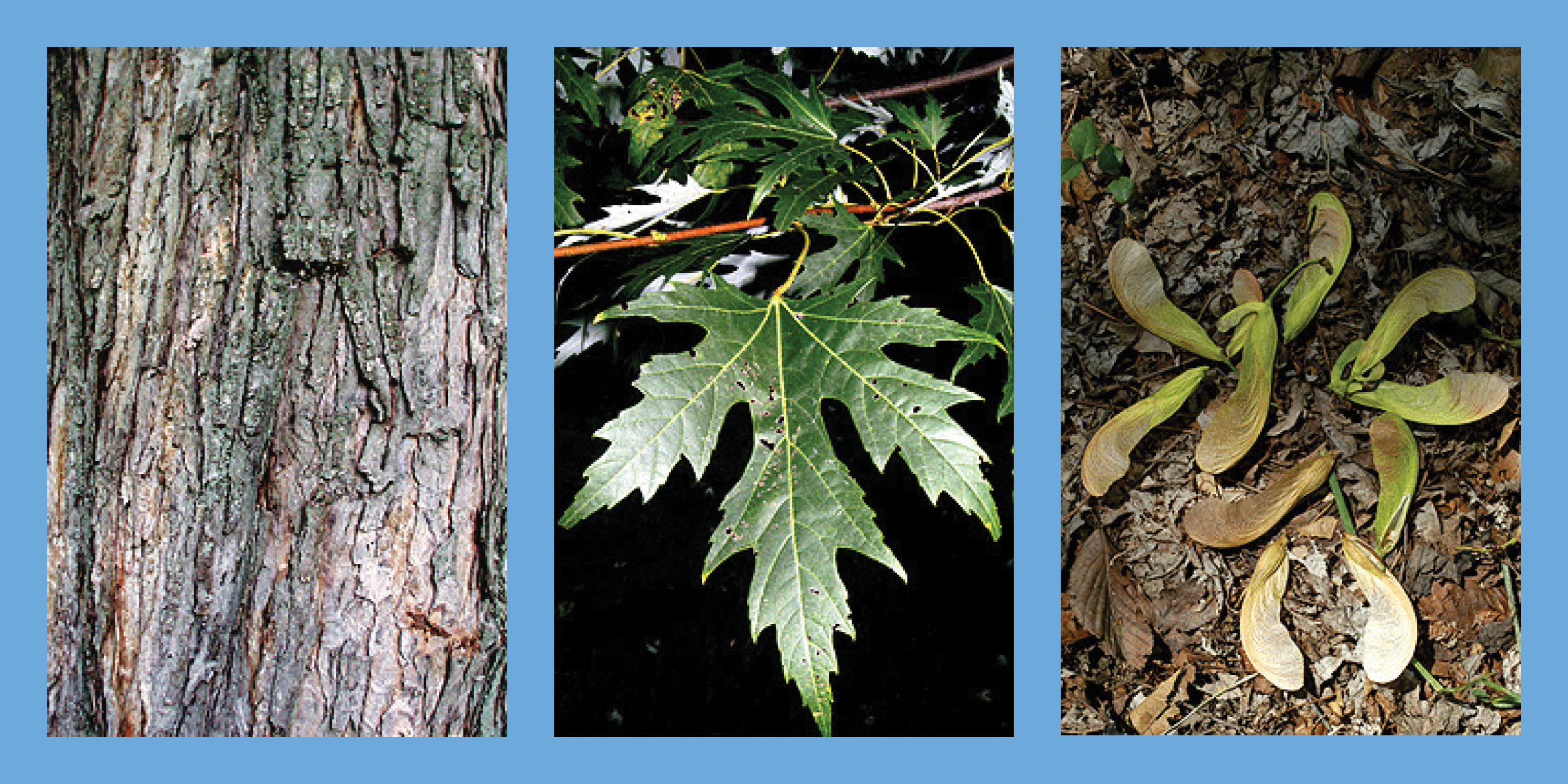
Tree Form: 50 to 80 ft. in height, Irregularly shaped crown with branches sweeping downward then curving upward. Trunk is often divided into several sub trunks.
Habitat: Prefers moist, rich soil such as stream banks, flood plains and lake edges.
Leaf: Opposite, Simple leaves, 2.5 to 5 in. long and wide. Coarsely toothed and Jagged leaf margins with 5 main lobes and Palmate venation. Very deep jagged sinuses more “u-shaped”. Leaves turn yellow-gray in fall.
Flower: Monoecious with small inconspicuous greenish to reddish flowers that appear in dense clusters before leaves in very early spring.
Fruit: Samaras, 1.5 to 3 in. long, green/yellow to light brown, Shallowly V shaped with spinning wings as they fall, viable for germination immediately.
Bark: Young bark is light gray and smooth, Older bark resembles long coarse vertical strips peeling upwards off of the trunk
Twig: Medium to thick twigs, Reddish to Chestnut brown, Opposite growth pattern, Reddish brown buds appear in dense clusters at tips of branches.
Tree use significance: This wood is soft and east to work, so it is often used for boxes, furniture and fuel. Preferred food of small animals with it’s buds and fruit. Often used as a landscape tree.
Sourwood
Oxydendrum arboreum
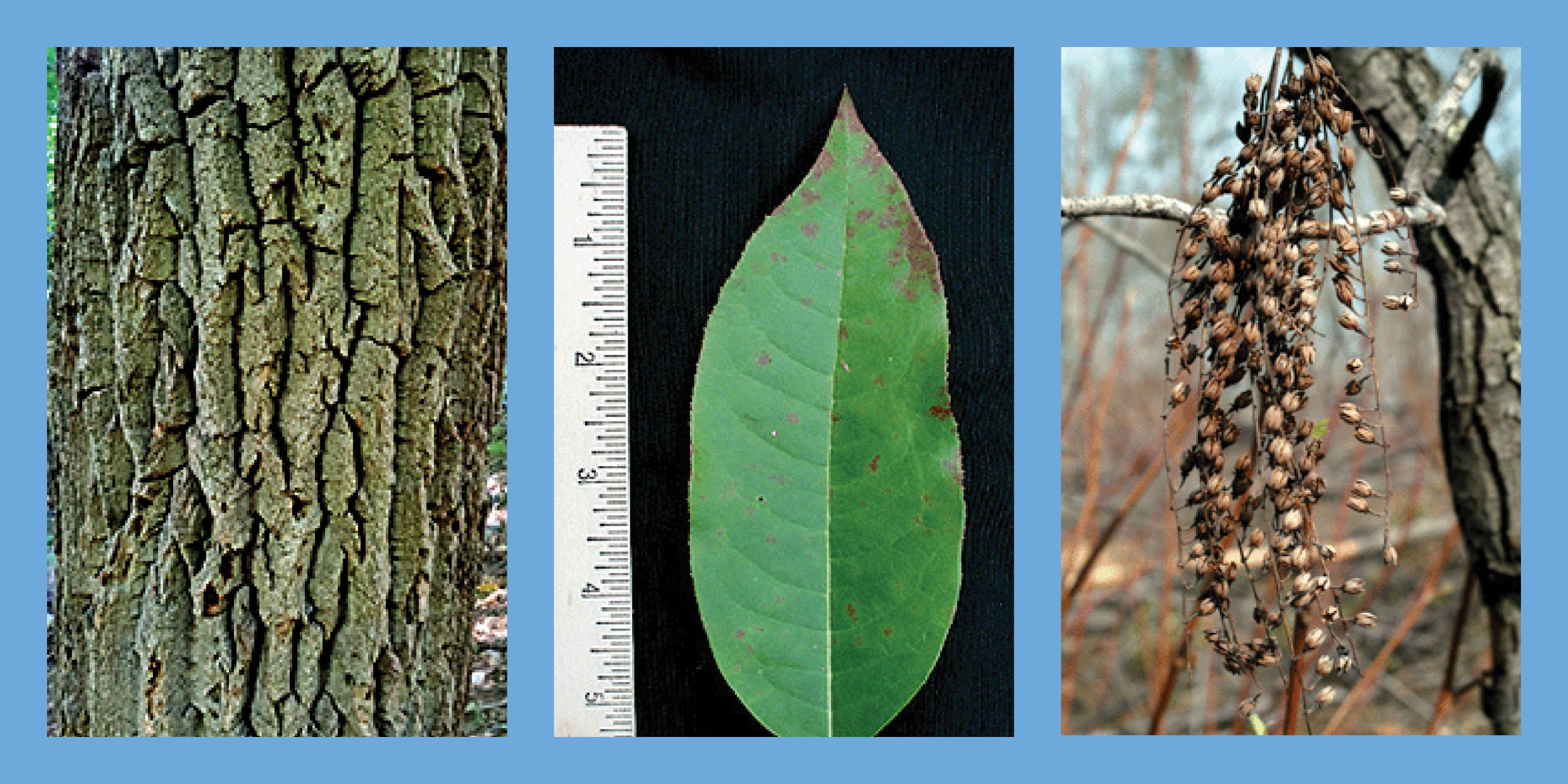
Tree Form: Medium-sized deciduous tree often with leaning trunk and crooked branches. Normally reaching heights of 25-50 feet. Young saplings appear as if the branches come off the main stem in layers.
Habitat: Forest understory tree found in acidic, well-drained soils.
Leaf: Alternate, simple leaves with an elliptical shape (4-7 in. long) and finely serrated edges; sour taste when chewed. Leaves are brilliant red, orange, or purple in the fall.
Flower: Small, fragrant, white bell-shaped flowers in drooping panicles, blooming in mid-summer. *similar to “lily-of-the-valley” flowers.
Fruit: Small, dry capsules grouped in clusters like fingers of an out-stretched hand. Fruits mature in the fall and persisting into winter.
Bark: Young bark is often reddish-tinted. Mature bark is grayish-brown, deeply furrowed and ridged, and develops a spiny appearance with age. *like the spine along an alligators back.
Twig: Slender, reddish-brown twigs with small buds. Branches come off the main trunk of seedings and saplings in a layered appearance (similar to whorled branches).
Tree use significance: Prized for ornamental planting due to its flowers and brilliant fall color. Bees feed from the flowers and Honey from sourwood flowers is highly valued. The wood is sometimes used for tool handles and fuel.
Striped Maple
Acer pensylvanicum
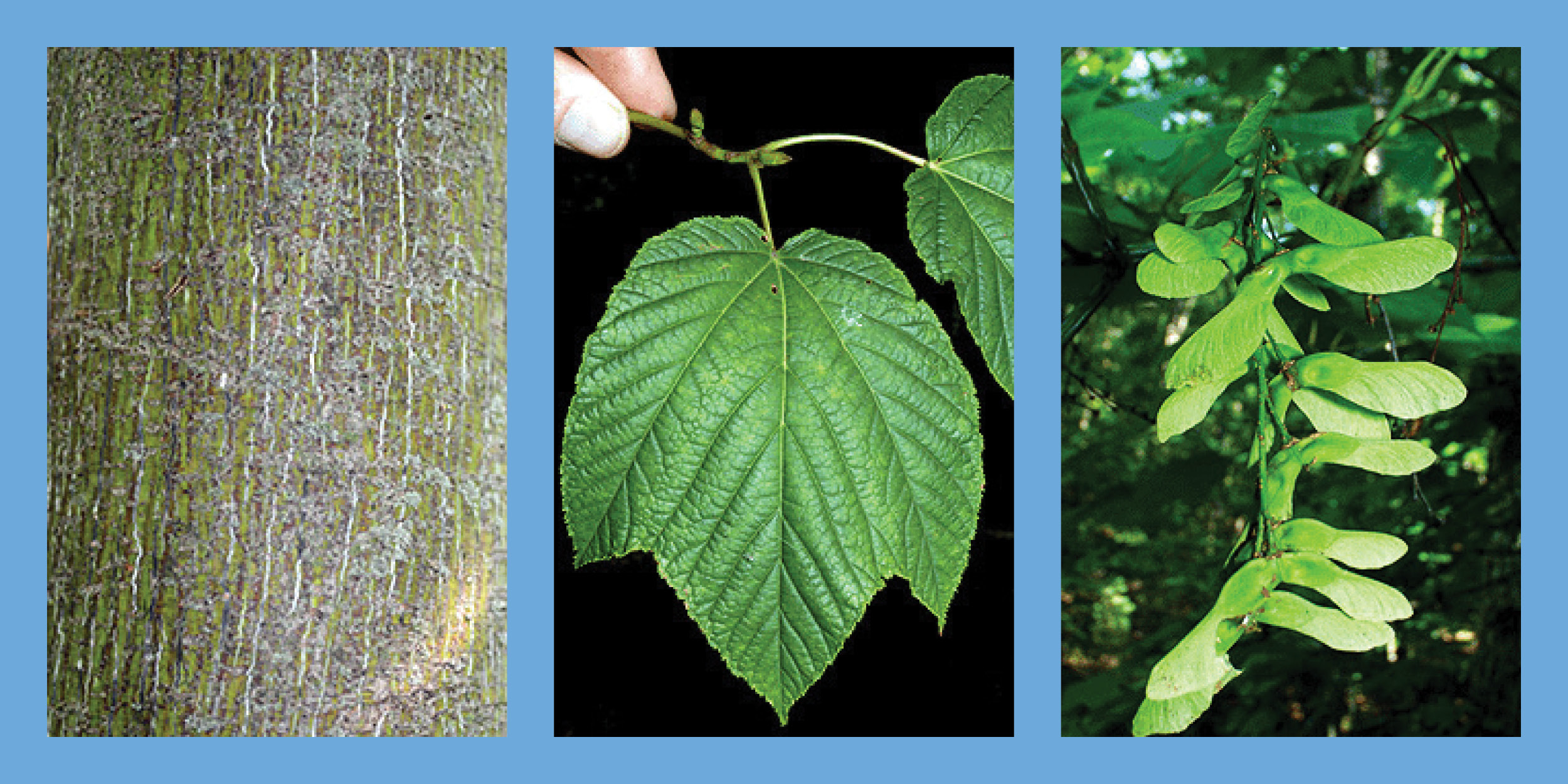
Tree Form: The stripped maple or commonly known as goosefoot maple, is a small tree up to 30 ft. tall. It has an open crown and it grows only to about 30 feet in height.
Habitat: Prefers cool shady slopes under larger hardwoods. protected from the sun. It also prefers well-draining moist soil.
Leaf: Opposite, simple, 4 - 5 in. long and 3 - 4 in. wide. It has 3 pointed lobes at the apex, resembling a goose’s foot, and has edges that are toothed. The sinuses are “V” shaped. The leaves are
Flower: The tree is dioecious with male and female flowers appearing on separate trees. Flowers are small and bell-shaped and bloom in the springtime before the leaves emerge. They have 4-5 petals and are about 1/4 in. in size. They are yellowish green and appear in long hanging clusters. They are typically present April through May.
Fruit: The fruit is a samara that is a paired wing with a shallow “v”. It is about 3/4 to a 1in. They ripen in late summer to early fall and appear in a greenish-cream color.
Bark: Young bark is smooth grayish green and has vertical white stripes which can turn more gray to reddish-brown as it grows. As it grows older it presents with shallow ridges that appear as strips.
Twig: The twigs are green and can change to reddish brown. They appear smooth and moderately thick with red buds. The buds are egg-shaped and/or duck-billed shaped.
Tree use significance: Native Americans used the stripped maple’s wood to make arrows and the bark for beverages. Wood used for inlay material for cabinets Farmers to feed leaves to cattle in the winter or turn cattle and horses loose to graze on the young buds/shoots in the springtime. Preferred food source for birds, deer and rabbits.
Sugar Maple
Acer saccharum
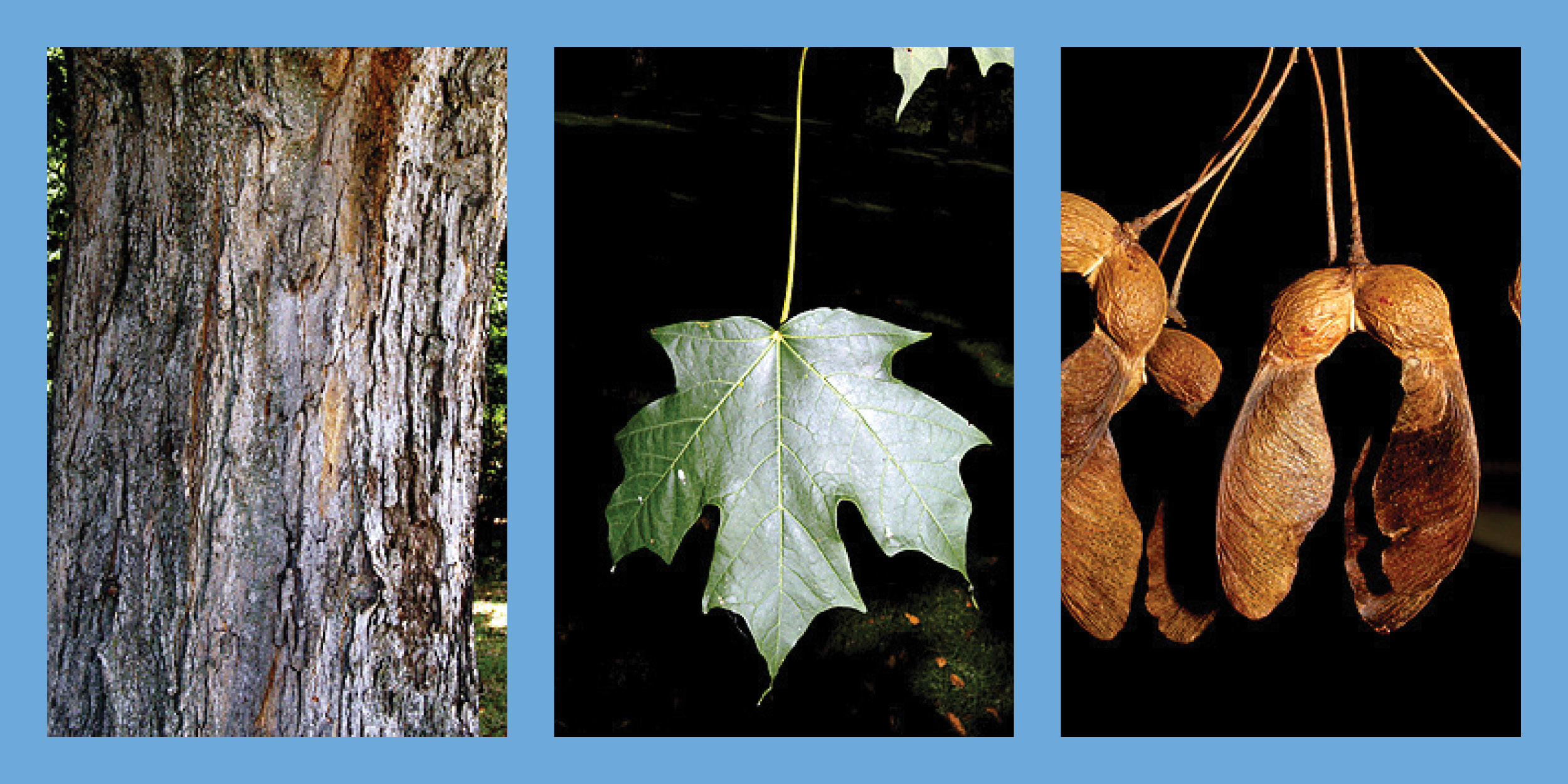
Tree Form: Large deciduous tree with an oval to rounded crown, reaching heights of 60-80 feet or more.
Habitat: Prefers well-drained, moist soils; commonly found in forests in eastern and central North America.
Leaf: Opposite, simple leaves with 3-5 palmate lobes with palmate venation. Leaves are 3-5 in long and wide with smooth margins but the tips of the lobes are pointed. Lobes are separated by shallow, rounded, “u” shaped sinuses. Leaves turn brilliant shades of red, yellow and orange in the fall.
Flower: Monoecious, small, insignificant greenish-yellow flowers hand from long, thin stems and appear in clusters in the early spring, often before leaves emerge.
Fruit: Clustered, paired, winged samaras grow on long, thin, drooping stems. Samaras are normally yellowish-orange colored and 1 in. long. Samaras will ripen in late spring or early summer and spin as they detach and fall to the ground. Samaras often appear before or as the leaves appear in the late spring.
Bark: Smooth and gray on young trees, becoming furrowed and darker brown/black in color with age. Mature trees will develop long, thick, irregular ridges that will curl outward.
Twig: Slender, shiny brown twigs with lighter lenticels and sharp pointed buds with tight scales.
Tree use significance: Valued for its close grain wood it if often used in furniture and flooring. Fruits and buds are a favored food for wildlife, especially squirrels, birds, mice, and deer. The trees’ sap is used to produce maple syrup. Considered a favorite tree for landscaping due to its quick growth, round crown for shade, and vibrant fall foliage.
Tulip-Poplar
Liriodendron tulipifera
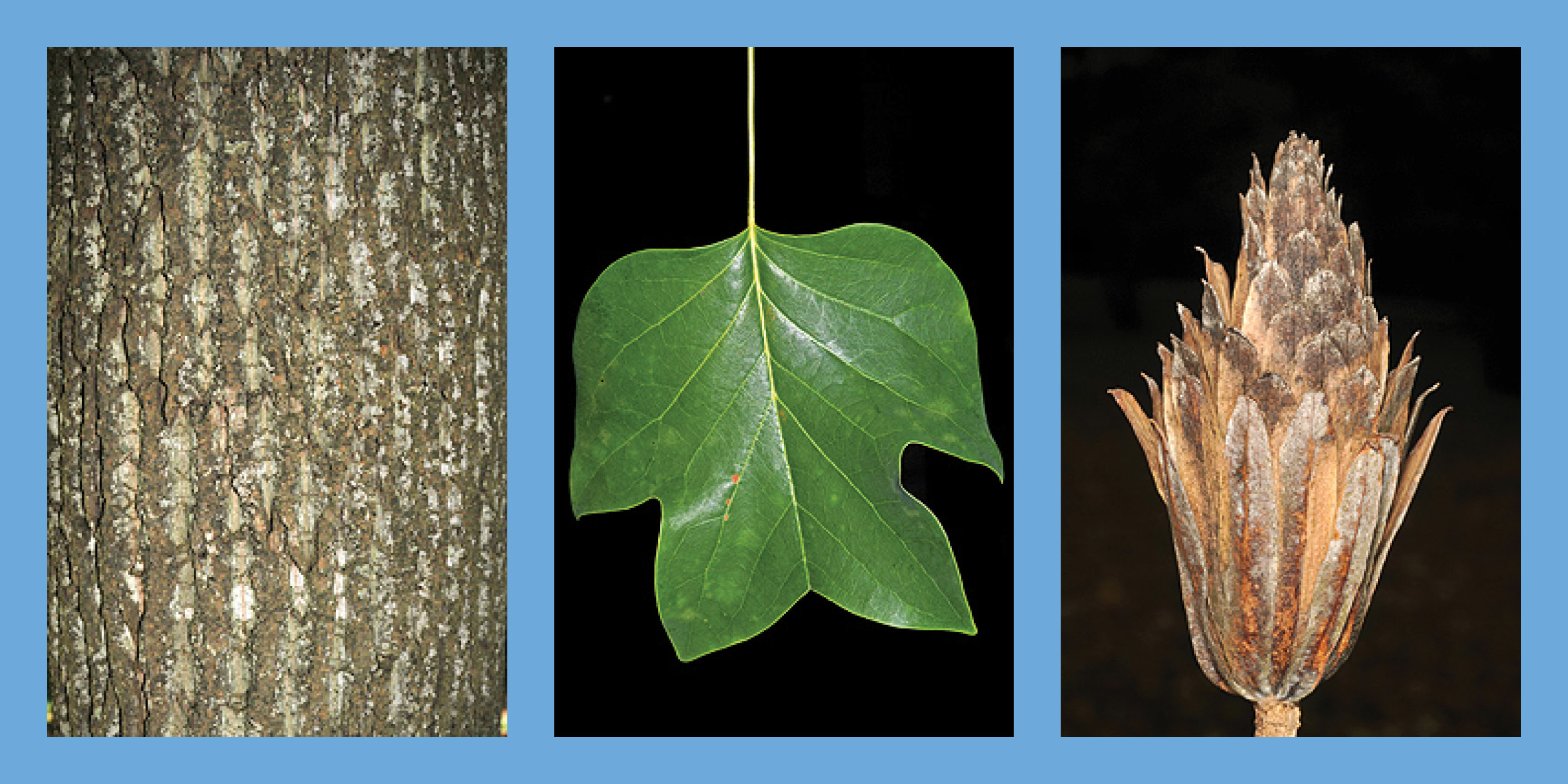
Tree Form: 60-110 ft. tall, long, straight, limb-free trunk with irregular crown in forest but pyramidal crown in open spaces. Branches grow in a horizontal angled pattern with lower branches pointing downward. Branch Scars create “frowny-faces” on trunk.
Habitat: Normally found in moist, well-drained soils, it often grows at lower elevations, like along river valleys and streams and hillsides, with plenty of moisture. Typically found on north and east-facing slopes with cool and humid conditions.
Leaf: Simple, alternate, 4-8 inches long and 3-6 inches wide, smooth margins with distinct lobes, uniquely shaped resembling a tulip flower or cat face. Leaves turn a golden-yellow in fall.
Flower: Monoecious, large, showy, with greenish-yellow petals, orange bands near the base, contain both male and female parts. Flowers in late spring, emerge after leaves are developed in summer.
Fruit: Cone-like fruit (1 in. wide) containing samaras, 2.5-3 inches long. Fruit is dry and light brown or tan as it matures in late summer to fall. Fruit resembles a small wooden flower or seed cone.
Bark: Smooth, grayish green on younger trees, thick and deeply furrowed on more mature trees, furrows run vertical, ridges are flat-topped, whitish or lighter gray on the higher edges, providing a noticeable contrast.
Twig: Thick, grayish-brown to reddish-brown and occur alternately along the branch. Buds are elongated and “duck-billed” shaped. Twigs give off a sweet-spicy odor if broken.
Tree use significance: Historically valued by Native Americans for its versatility in crafting tools and creating shelter. The light, soft, and easily workable wood of the Yellow-Poplar is highly valued in construction. It is used for making furniture, cabinets, plywood, etc. The tree’s rapid growth and broad canopy make it an excellent choice for providing shade in larger gardens or as a street tree in warmer climates.
Gymnosperms
Ginkgo / Maiden Hair
Ginkgo biloba
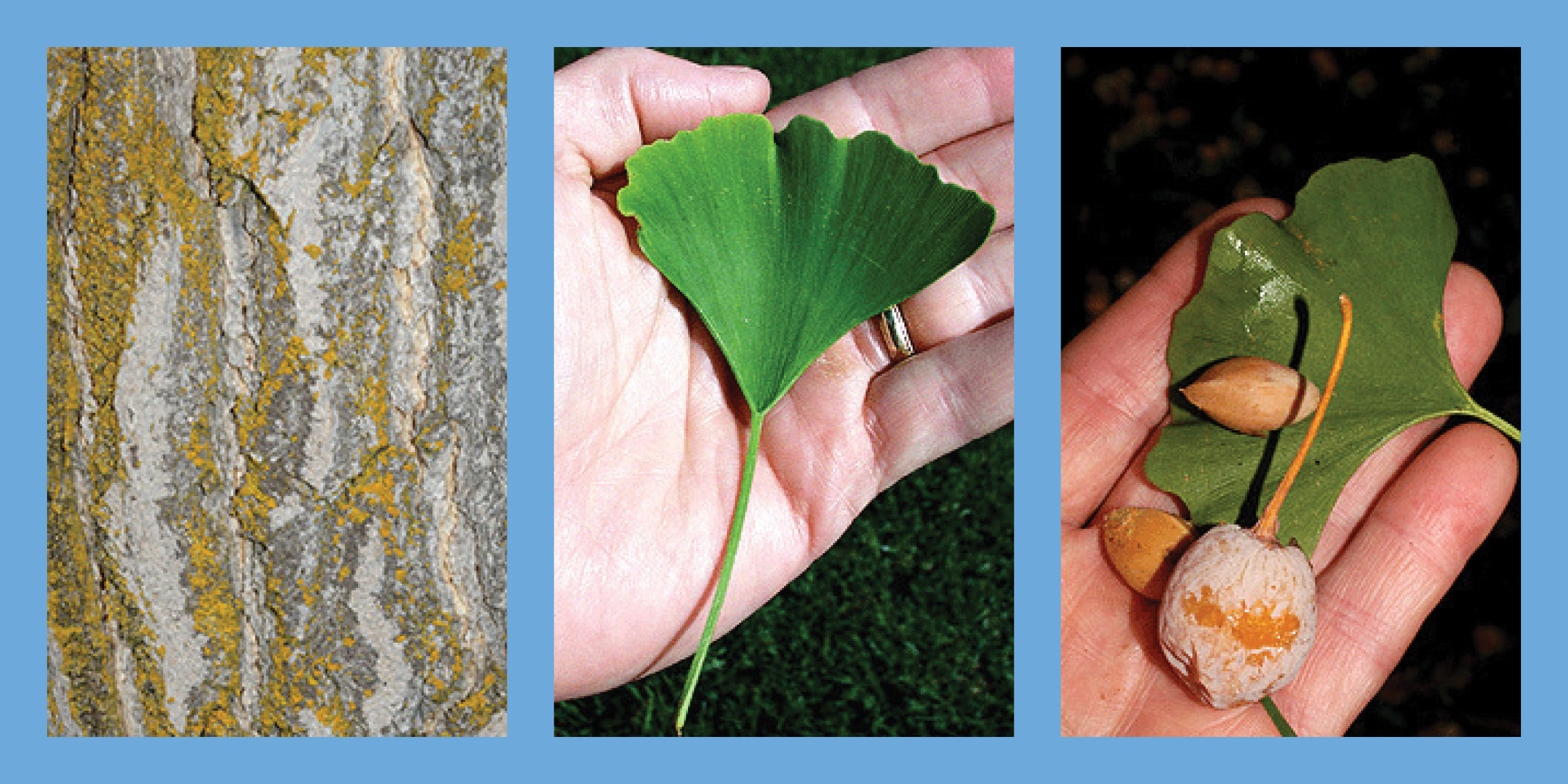
Tree Form: Ginkgo is a unique Broadleaf Deciduous Conifer generally reach heights of 50 to 80 feet. The branch pattern can be quite variable, contributing to the unique character of each tree; male tree branches tend to be more upright, while female trees often have a broader, more spreading form with branches drooping downward.
Habitat: Ginkgo biloba is native to China. Trees prefer temperate climates with moist, well-drained soil. Ginkgos are popular for city planting because of their tolerance for pollution and they thrive in full sun.
Leaf: Simple leaf that originates as a cluster from a 1-2 in/ bract on the limb. Leaves are typically 2 to 3 inches long and up to 4 inches wide; distinctly fan-shaped. The veins appear palmate because they radiate out from the base of the leaf but are actually dichotomous as they divide along the length of the leaf.
Flower: Dioecious, with small male strobili/cones that resemble catkins and female strobili consisting of a stalk with two ovules at the end, both forming on separate trees. the fleshy, yellow, apricot-like structures that develop on female Ginkgo trees are often mistaken for fruit but are actually seeds with a fleshy outer layer.
Fruit: The fleshy, yellow, apricot-like structures that develop on female Ginkgo trees are often mistaken for fruit but are actually seeds with a fleshy outer layer and since they did not develop from flowers they are not technically fruit.
Bark: Young - light gray to grayish-brown, smooth with shallow fissures. Mature - darker gray or brown, pronounced 2 in. wide, flat-topped ridges and shallow furrows. Furrows deepen and become more interconnected with age.
Twig: Moderately stout, not thin or thick; Young twigs start out light brown gradually turn gray. Twigs are usually small and cone-shaped, with a reddish-brown color.
Tree use significance: Symbolically it has been used as a sign of hope and peace an the Asian culture. Medicinal/Food use for traditional Chinese medicine. Most often found planted on Research Universities and Hospital grounds as it is a symbol of knowledge and education as derivatives of the tree are known to increase learning and memory.
Virginia Pine
Pinus virginiana
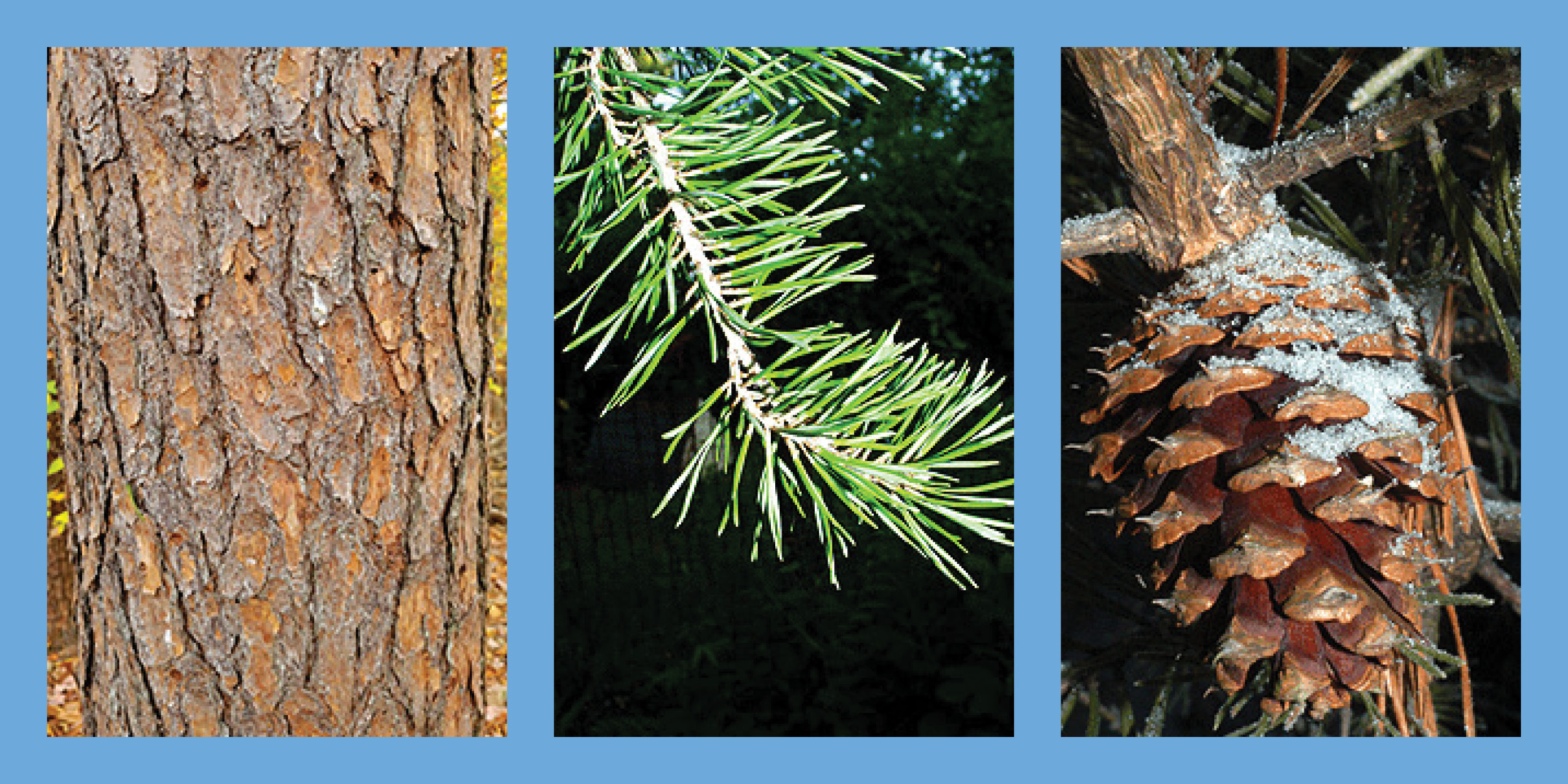
Tree Form: Small to medium size up to 70 feet tall, develops a flat top crown with dead, gray, upward angled branch stubs common on the lower part of trunk.
Habitat: Grows best on clay, loam, or sandy soils that are moderately to well drained.
Leaf: Evergreen needles, 1 1/2 to 3 in. long, with 2 yellowish-green, twisted needles per fascicle.
Flower: Monoecious trees; males cones are cylindrical, yellow, near branch tip; female cones are yellow to red with curved prickles
Fruit: Woody cone with conical-oval shape are 1 1/2 to 2 1/2 in. long, reddish-brown with spiny-scales. Cones sit flat on branches and have a sharp prickle at the end of each scale.
Bark: Young trees are orange-brown and scaly; older trees develop thin, scaly plates about 2 in. wide x 3 in. long. Copper-colored patches are often found trunk.
Twig: Slender, yellowish-green and smooth when young, and turn gray-brown when older. Have a glaucous bloom that changes it to purplish-green.
Tree use significance: Wood has long fibers and is commonly used for pulpwood. Provides food and shelter for various wildlife, woodpeckers like to nest in older decayed trees. Needles and gum are used to scent soap.